How to increase traffic to an online store in 2026 without paying for ads?
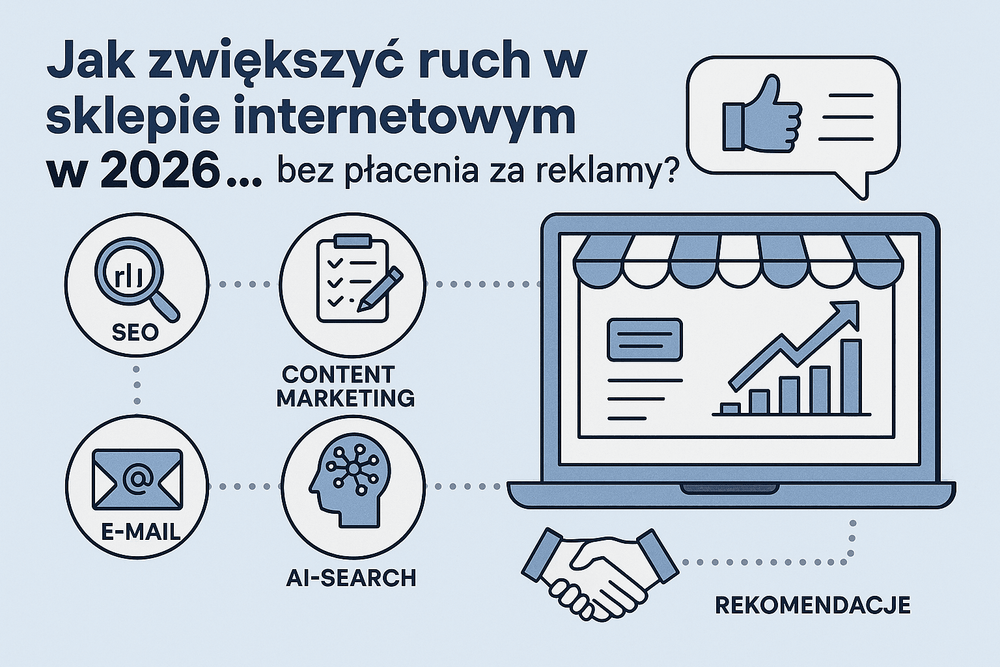
source: own elaboration
In 2026, running an online store without a budget for paid advertising (Google Ads, Facebook Ads, Allegro Ads, etc.) sounds like masochism. Cost-per-click rates keep rising, ad space is packed to the brim, and platforms are increasingly eager to keep customers “within their own ecosystems” rather than send them to external websites.
Yet it is still possible to build solid, growing traffic—based on SEO, content, community, email, referrals, and a new phenomenon: visibility in AI-powered search engines (GEO, AEO). This requires time, consistency, and strategic thinking, but it does not require pouring money into advertising systems.
Below is a guide on how to approach this wisely in the realities of 2026.
1. Understand where e-commerce traffic actually comes from
Before you start “increasing traffic,” it’s worth understanding what you’re really competing for.
Analyses of e-commerce traffic sources show that the largest shares usually come from:
-
direct traffic (bookmarks, typing the address, app referrals),
-
search engine traffic (organic search),
-
social media traffic,
-
email traffic,
-
referral traffic and marketplaces.
In one overview of e-commerce traffic, on average about 27% of traffic came from direct visits and about 22% from organic search results, which shows how important brand recognition and SEO are.
Meanwhile, global web traffic data indicates that organic search results can generate up to 10 times more traffic than organic social media, underscoring that SEO remains one of the most important long-term sources of visits.
In addition, in 2025–2026 a new source has emerged: traffic from generative AI—from ChatGPT, Copilot, and other assistants that increasingly provide links to stores as answers to user questions. Adobe reports a year-over-year increase of several hundred percent in traffic to retail sites from generative AI tools.
If you don’t want to pay for ads, your strategy must be based on maximizing the use of organic search, direct traffic, email, social media, referrals, and AI search.
2. SEO in 2026: the foundation of free traffic
3.1. SEO is no longer just “Google rankings”
In 2026, SEO stops being solely a fight for positions in classic search results. You need to think more broadly:
traditional SEO – visibility in Google / Bing organic results,
AEO (Answer Engine Optimization) – so your content is cited in answer boxes, featured snippets, and AI overviews,
GEO (Generative Engine Optimization) – so AI assistants (ChatGPT, Gemini, Copilot, etc.) are eager to use your content as a source.
The common denominator: search engines and AI models need clear, reliable, well-structured information.
2.2. Technical SEO: the store must be “readable” for bots
Without technical order, it’s hard to talk about growing organic traffic. Priorities include:
Speed and performance – optimizing Core Web Vitals, lightweight images, sensible caching.
Mobile-first – the store must work perfectly on mobile, as most traffic already comes from smartphones.
Logical architecture – clear category structure, filtering without content duplication, friendly URLs.
Proper metadata (title, description), H1/H2 headings, and internal linking structure—so bots understand content hierarchy.
Schema.org / structured data – products, reviews, FAQs, breadcrumbs, local business—everything that helps search engines and AI “understand” what you sell.
This doesn’t require an ad budget—just time (your own or a specialist’s).
2.3. Content aligned with user intent
A key shift in SEO for 2026 is the growing importance of E-E-A-T (Experience, Expertise, Authoritativeness, Trustworthiness).
For a store, this means:
-
reliable product descriptions, based not only on specs but also on practical experience (e.g., “we tested this product…”),
-
rich category descriptions answering common questions (“how to choose the right size,” “which version for beginners,” etc.),
-
guides, reviews, comparisons—not just “what X is,” but “how to choose X for…,” “the most common mistakes when buying X.”
AI assistants and search engines favor content that directly answers specific questions—in Q&A formats, FAQ sections, steps, and checklists. This is the essence of AEO / GEO.
3. Blog and content marketing: free traffic that grows over time
Studies show that companies running a blog can generate up to 55% more organic traffic than those that don’t.
Other analyses indicate that content marketing leaders achieve over seven times more website traffic than companies that barely invest in content.
This is no coincidence. A well-run store blog:
-
increases the number of keywords the store ranks for,
-
attracts long-tail traffic (specific problems, questions, situations),
-
builds expert brand authority, which directly supports conversion.
3.1. What content should you create to actually increase traffic?
Instead of random articles, it’s worth focusing on a topic strategy:
Buying guides
“How to choose [a product] for [a specific use] in 2026?”
“What to look for when buying [a product] for the first time?”
Rankings and comparisons
“Top 10 [products] for beginners”
“[Product A] vs [Product B] – what to choose in 2026?”
Problem-oriented content
“Why [a product] breaks / doesn’t work as it should – the most common mistakes”
“How to extend the lifespan of [products] – a practical guide”
Seasonal and trend-based content
“[Product category] – trends for 2026”
“Gifts for [holiday/event] for fans of [topic] – concrete suggestions.”
Most of these texts can be written once, updated annually, and generate traffic continuously.
3.2. Content formats: text, video, short-form
According to marketer research for 2024 and 2025, the most promising format is short-form video for social media—Reels, Shorts, TikTok.
In practice:
-
you write a long-form blog guide,
-
turn it into several short clips, infographics, or slides for LinkedIn/Instagram,
-
everything links back to the full article on the blog or in the store.
The result: one well-thought-out topic can generate traffic from Google, social media, and—more and more—from AI-powered search engines.
4. Social media without an advertising budget
Organic reach on social media can be unpredictable, but it remains one of the main ways people discover brands. Global data shows that search engines and social media are the two most important channels through which users learn about new brands and stores.
In 2026, social media is no longer just a “store fan page,” but an entire ecosystem:
-
short-form video (TikTok, Reels, Shorts),
-
live shopping streams,
-
creator collaborations—often commission-based rather than fixed campaign fees,
-
thematic groups and communities, platforms like Discord or forums.
4.1. What works without paying for promotion?
Series instead of one-off posts Instead of random content:
-
“30 days with [a product category] – one concrete tip or trick every day”
-
“Live Monday Q&A”
-
“Once a week: a customer case study.”
-
Algorithms favor predictable, regular formats.
User Generated Content (UGC)
-
encourage customers to publish photos/videos featuring your products,
-
offer discounts or bonuses for tagging your store,
-
create a “community wall” on your website—this increases trust and CTR.
Collaborations with micro-influencers
Instead of chasing big-name stars with high fees, look for creators with engaged, niche communities.
Compensation models include:
-
product seeding / barter,
-
affiliate programs (commission on sales),
-
joint live streams and events.
Presence in groups and communities Not as an “aggressive seller,” but as an expert.
-
answer questions,
-
share your articles when they genuinely solve a problem,
-
over time, you become “the go-to store for [topic].”
5. Email marketing: the channel with consistently the best ROI
Despite its “old age,” email marketing still delivers impressive results. The average return on investment for email is estimated at around $36 in revenue for every $1 spent, or roughly 3600% ROI—figures confirmed by many industry reports in recent years.
And we’re not talking about spam, but about:
-
newsletters,
-
educational campaigns,
-
automation (abandoned carts, post-purchase follow-ups, product recommendations).
5.1. How to increase traffic from email without paying for ads?
-
Collect addresses wherever it makes sense
-
on-site pop-ups (used thoughtfully),
-
a checkbox during checkout,
-
lead magnets: “checklists,” “mini e-books,” “discount code for signing up.”
Build a meaningful newsletter, not just promo blasts
-
short guides,
-
product inspiration,
-
customer case studies,
-
announcements of new blog content.
A newsletter can be one of the main sources of returning traffic—if it delivers real value to subscribers.
Behavior-based automation Even simple workflows (abandoned cart reminders, product reminders, review follow-ups) can recover sales each month that would otherwise be lost—and every click means additional traffic.
6. GEO and visibility in AI-powered search engines
A new piece of the puzzle in 2026 is Generative Engine Optimization (GEO)—optimizing content for AI-driven search engines. The growing share of traffic from chatbots and assistants means brands are starting to think not only “how to rank in Google,” but also “how to be referenced by ChatGPT, Gemini, or Copilot.”
6.1. What can you do in practice as an e-commerce store?
Structure content around specific questions
-
FAQ sections on category and product pages,
-
Q&A-style articles: “The most common questions about [product category],”
-
clear, concise answers within texts—AI assistants like sentences that are easy to quote.
Ensure structured data and brand information consistency
-
schema.org (products, FAQs, organization),
-
consistent address and NAP data, brand descriptions in directories and profiles,
-
a clear “About Us” page—who you are, how long you’ve been operating, what makes your store different.
Build brand recognition In 2026 trends, the importance of branded searches is growing strongly—users increasingly type a specific store or brand name into Google or AI chat. The more often your brand appears in connection with a given topic (blog, social media, collaborations, forums), the more readily AI models will associate it with that category.
Create your own tools / configurators / calculators A simple tool (“choose the right [product] for your needs”) can be widely linked, discussed, and recommended by others—including AI assistants, which like to point users to ready-made tools.
7. Traffic from referrals, partnerships, and affiliate programs
If you don’t want to spend on ads, you can pay only for results, not clicks—or build traffic entirely cost-free through collaboration.
7.1. Customer referral programs
-
discounts for both the referrer and the referred customer,
-
loyalty points redeemable for discounts,
-
extra bonuses for social media referrals (e.g., contests for users who showcase your product on Instagram).
When fair and simple, such initiatives can create a steady flow of new users without relying on ad systems.
7.2. Affiliate marketing and content partnerships
-
bloggers, YouTubers, and niche creators earn a commission on sales generated via their links,
-
you don’t pay for campaigns, only for completed transactions,
-
often a simple affiliate panel or integration with an external platform is enough.
Add to this guest blogging / partner articles—content exchanges between blogs, industry portals, interviews with you as an expert. This delivers:
-
backlinks (SEO),
-
traffic (the partner’s audience visits your store),
-
stronger brand authority.
8. UX and conversion—because traffic alone doesn’t matter
Although this article focuses on “traffic without paying for ads,” one fact can’t be ignored: nothing is more expensive than traffic that doesn’t convert.
That’s why, alongside acquisition, you should:
-
simplify the checkout flow (fewer steps, clear shipping costs),
-
ensure clarity of the offer and filters,
-
highlight reviews, user photos, and sections like “frequently bought together,”
-
provide fast answers to questions (chat, FAQ section, clear contact details).
Without this, you’ll simply be “burning” organic traffic that you worked so hard to earn.
9. A 6-month plan—how to structure it over time
Finally, here’s a suggested way to structure your efforts over roughly six months, assuming you don’t have a large team or an ad budget.
Months 1–2: foundations
-
Technical SEO audit (speed, mobile, URL structure, structured data).
-
Clean up categories and key product pages.
-
Create the first 4–6 blog articles (guides, rankings, FAQs).
-
Launch a simple newsletter and sign-up forms.
Months 3–4: content and social escalation
-
Regular publishing: 1–2 articles per week, each supported by short-form social content.
-
Expand category pages with FAQ sections and “how to choose…” content.
-
Join 1–2 niche communities (Facebook groups, Discord, forums) as a store-expert.
-
Launch a simple customer referral program.
Months 5–6: GEO, automation, and partnerships
Review content for AEO/GEO: add clear Q&A answers, FAQs, structured data.
Implement basic email automations (abandoned carts, follow-ups, recommendations).
Test initial affiliate or barter collaborations with micro-influencers.
Create one “flagship” guide or tool that can be promoted as a main traffic magnet.
After six months, you won’t be “dominating” the market yet, but you should see:
-
growth in the number of keywords you rank for organically,
-
an increasing share of returning traffic (direct + email),
-
first visits from referrals, partnerships, and—gradually—from AI-powered search engines.
Summary: no ad budget, but not “cost-free”
Increasing traffic to an online store without paying for ads in 2026 is like training without doping: still possible, but it requires:
-
systematic SEO work (technical + content),
-
consistent content marketing (blogs, guides, video),
-
smart use of email as a key return channel,
-
presence in social media and communities without desperate selling,
-
building referrals, partnerships, and affiliate programs,
-
thinking about GEO / AI search before your competitors do.
You may not spend money—but time and attention will always be the currency. If you invest them in a well-structured strategy, you’ll build traffic that no single change in ad algorithms can wipe out overnight.