How to Lower CPC in Performance Max: 5 Steps to AI Feed Optimization
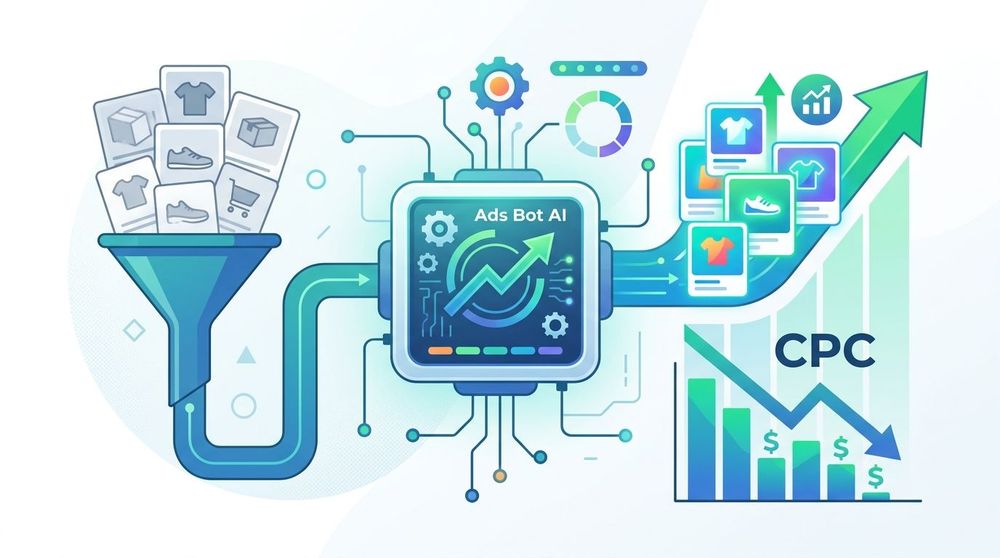
source: own elaboration
How to Lower CPC in Performance Max: 5 Steps to AI Feed Optimization
Performance Max (PMax) campaigns have revolutionized how e-commerce brands reach customers within the Google ecosystem. By consolidating search, display, shopping, YouTube, and Gmail into a single campaign type, Google has promised unprecedented reach and efficiency. However, for many marketers and online store owners in Europe, PMax has become synonymous with a "black box"—a system that generates high cost-per-click (CPC) rates and quickly drains advertising budgets if not provided with top-quality data. The key to taking control of Google's algorithms and radically reducing traffic acquisition costs is optimizing the product feed.
In today's highly competitive e-commerce environment, manually updating thousands of products is practically impossible. This is where ready-made AI solutions, such as Ads Bot AI by TrafficWatchdog, come to the rescue. In this article, we will guide you through 5 key steps to optimize your product feed using artificial intelligence, reduce CPC by up to 35%, and significantly improve your ROAS.
The European E-commerce Landscape: Cost Pressure and the Role of AI
The adoption of artificial intelligence in the European B2B and e-commerce sectors is growing at an unprecedented pace. Businesses are looking for ways to optimize margins in the face of rising media costs and high inflation rates. According to Eurostat 2025 data, the average adoption of AI technologies in EU enterprises (EU27) has reached 20.0%, with countries like Denmark (42.0%), Finland (37.8%), and Sweden (35.0%) dominating the market. In Poland, this index stands at 8.4% but is growing dynamically—especially in the retail and wholesale sectors, where more than half of the entities have already initiated implementation processes.
Key fact: According to a Bain & Company 2025 study, companies using integrated artificial intelligence systems in marketing and advertising report a ROAS increase of 10% to 25% and a reduction in ad creative production time of 30% to 50%.
Unfortunately, many companies fall into the trap of "SaaS fatigue" or "Pilot Purgatory". The global McKinsey State of AI 2025 report indicates that although 78% of organizations declare using AI, only 5.5% can translate these implementations into a real EBIT increase exceeding 5%. A common reason for failure is relying on inconsistent input data (so-called dirty data) and a lack of tool integration with actual business processes. In e-commerce, this "dirty data" corresponds to a disorganized, poor product feed, which prevents Google's algorithms from properly matching ads with user queries.
Why Is This the Best Time to Implement AI in Google Ads?
First, search engine competition is stronger than ever. Traditional bid optimization methods are giving way to automated Smart Bidding strategies. This means that the only area where an e-shop can realistically build a competitive advantage in Google Ads is the quality of the provided data (the feed) and creatives. If your feed contains errors, missing attributes, or poorly optimized titles, the machine learning algorithms will overspend on irrelevant traffic, raising your CPC.
Second, starting in August 2026, key regulations of the European Union Artificial Intelligence Act (AI Act) will come into force, imposing strict transparency requirements on generative systems. Tools such as chatbots or marketing graphic generators must fully comply with the new legal regulations and GDPR requirements. Choosing a proven, secure AI software provider that guarantees compliance with European legislation is becoming a priority for every mature B2C and B2B business.
Before we dive into the specific steps, let us compare three approaches to product feed optimization in e-commerce:
| Feature | No Automation (Manual Editing) | In-house AI Solution | Ready Product (Ads Bot AI + CSS) |
|---|---|---|---|
| Implementation Time | None (continuous manual work) | From 3 to 6 months (high risk of delays) | Instant (ready-made feed integration) |
| Impact on CPC Costs | No impact (often increases CPC) | Depends on the quality of the in-house algorithm | Reduction of approx. 15% (Ads Bot) + 20% (CSS) |
| Error Elimination (GMC) | Reactive (after products are disapproved) | Requires constant developer supervision | Proactive (automatic error resolution) |
| Asset Creation | Expensive outsourcing (graphic designer, video) | Limited to basic templates | Automatic generation of graphics, videos, and texts |
5 Steps to AI Feed Optimization
Step 1: Automatic Enrichment and Structuring of Titles and Descriptions
The Google Performance Max algorithm matches ads to user queries based on semantics. If your product is simply named "Summer dress", the chance of winning the auction at a low CPC is minimal. Google's search engine relies on contextual signals to match products with highly specific search queries. Without these details, your product is bid on broad, highly competitive search terms, driving up costs.
Ads Bot AI automatically analyzes your inventory and restructures product titles and descriptions. It adds key attributes searched by users (so-called long-tail keywords), such as brand, model, color, material, or size. For instance, "Summer dress" becomes "Nike Women's Summer Dress Floral Print Blue Size M". A precisely structured title increases the click-through rate (CTR) and makes Google evaluate the ad as more relevant, which directly translates to a reduction in the average CPC by about 15%.
Step 2: Proactive Error Elimination in Google Merchant Center
Disapproved products in Google Merchant Center (GMC) represent a direct loss of revenue. Price discrepancies between the feed and the website, missing required attributes, or incorrect image links can block key products from being displayed. Manual checks of GMC accounts are time-consuming and reactive, meaning you only notice an error after your traffic has already dropped.
The artificial intelligence in Ads Bot AI operates continuously. It scans the product feed, identifies errors, and automatically fixes them before Google's systems can apply a disapproval. By cross-referencing your website's structured data with your XML feed in real-time, it ensures that prices, stock levels, and product details are perfectly aligned. As a result, your store maintains 100% visibility in the Shopping tab.
Step 3: Generating Smart Ad Assets (Asset Group)
Performance Max is a dynamic format. To function correctly, it requires not only text data but also high-quality graphics, headlines, and videos. The lack of these elements causes Google to automatically create unappealing and poorly converting collages from random product photos, which can damage your brand image and lower your conversion rate.
Ads Bot AI solves this problem by automatically generating attractive ad banners, catchy headlines, and short promotional videos tailored for YouTube, Gmail, Search, and Display. By analyzing which visual patterns perform best in your industry, the AI dynamically creates assets that match user intent. The high quality of these components increases the campaign's Quality Score, which allows you to win ad auctions at significantly lower rates.
Key fact: According to a Sopro 2025 report, marketing process automation allows for a 75% reduction in campaign launch time, while simultaneously increasing CTR by an average of 47%.
Step 4: Utilizing the Comparison Shopping Service (CSS) Structural Discount
This is the step that yields the fastest and most spectacular financial results in Europe. In 2017, the European Commission imposed an antitrust fine on Google for favoring its own comparison shopping service. Consequently, Google was forced to allow external CSS partners to enter the auction on equal terms, creating a level playing field.
What does this mean for you? By using a certified CSS partner such as Trafishop (available as an add-on to Ads Bot AI), you automatically recover approximately 20% of the commission that Google standardly retains for itself. When you bid through Google Shopping, Google takes a 20% margin off your bid to cover internal costs. Through Trafishop CSS, 100% of your bid goes directly into the auction.
- Synergy effect: By combining feed optimization via Ads Bot AI (~15% CPC reduction) with switching to the CSS model (~20% discount), you can achieve up to 35% more clicks while maintaining the same advertising budget.
- Safety: Implementing CSS does not require abandoning your current campaigns or changing your marketing agency—campaigns can run in parallel, allowing for a safe comparison of results.
Step 5: Building Organic-Paid Synergy with Blog Agent AI
Modern e-commerce marketing does not end with paid ads. The real sales flywheel is created when data from paid campaigns fuels organic efforts, lowering your overall blended customer acquisition cost (CAC).
Combining Ads Bot AI with the Blog Agent AI module allows for the automatic generation of unique blog articles optimized for traditional SEO and modern AI Search (Google SGE, Bing Copilot, Perplexity). The AI Agent analyzes the product feed and data on the best-converting products from Google Ads, then creates guides and rankings, driving free, high-intent traffic directly to your store. This ensures that even if ad costs fluctuate, your store maintains a steady stream of organic conversions.
What Makes Ads Bot AI Stand Out on the Market?
While most agencies and tools on the market focus solely on manual bid adjustments or basic XML file editing, Ads Bot AI by TrafficWatchdog offers a comprehensive, autonomous approach:
- Full 24/7 automation: The system continuously updates data in the feed with every change in inventory or pricing in your store.
- CSS structural discount: As one of the few solutions on the market, Ads Bot AI combines advanced optimization algorithms with direct access to cheaper clicks under the Trafishop CSS program.
- Flexible pricing scaled to size: The solution is available in three subscription packages (Starter for 300 PLN, Growth for 500 PLN, and Pro for 1000 PLN per month), allowing for cost optimization regardless of the size of the product database (from 10,000 to 50,000 products).
Frequently Asked Questions (FAQ)
1. Do I need to stop working with my current marketing agency to implement Ads Bot AI?
No. Ads Bot AI operates at the level of product data and feed optimization. Your agency can continue to manage the campaigns and budgets in Google Ads, while our tool provides them with perfectly prepared input data. This collaboration often drastically improves the results achieved by the agency.
2. Is switching to the Trafishop CSS program safe for my existing campaigns?
Yes, 100%. Switching to CSS does not require resetting your Google Ads account history or pausing active campaigns. We can also launch a CSS campaign as a separate structure alongside your current efforts so you can independently verify the decrease in CPC costs.
3. What are the product limits in each Ads Bot AI package?
- Starter Package (300 PLN/mo): Scanning and optimization of up to 10,000 product pages.
- Growth Package (500 PLN/mo): Scanning and optimization of up to 25,000 product pages.
- Pro Package (1,000 PLN/mo): Scanning and optimization of up to 50,000 product pages.
Note: You can add the CSS add-on to any package for only 100 PLN per month.
4. Are the AI-generated graphics and texts compliant with the EU AI Act?
Yes. All tools in the TrafficWatchdog portfolio are designed with full compliance in mind regarding European legal regulations, including the upcoming AI Act requirements of August 2026 and GDPR regulations on privacy and personal data protection.
Key Performance Indicators
| Indicator | Before Implementation | After Implementation | Source |
|---|---|---|---|
| Cost per click (CPC) in product campaigns (CSS) | 100% of base rate | Reduction by 20% (80% of base rate) | Trafishop / CSS documentation (EC Antitrust Discount) |
| CPC optimization via AI product feed | Standard feed without AI automation | CPC drop up to 35% | Ads Bot AI / TrafficWatchdog product documentation |
| Auction commission charged by Google | Approx. 20% of click value retained by Google Shopping | 0% (100% of commission goes to the store's advertising budget) | European Commission 2017 decision on Google Shopping monopoly |
Summary
Lowering CPC in Performance Max does not require drastically cutting advertising budgets. It requires providing Google's algorithms with top-quality data. Implementing Ads Bot AI from TrafficWatchdog allows for:
- Radical reduction of click costs (CPC): Savings of up to 15% through AI feed optimization and an additional 20% through the Trafishop CSS structural discount.
- Increased reach and visibility: Better matching of products to long-tail queries and elimination of GMC disapprovals.
- Time and budget savings: Automatic generation of graphic, video, and text assets without the need to involve external agencies or graphic designers.
- Legal safety: Full compliance with EU AI Act requirements and GDPR.