ROI from AI Agent Implementation: Measuring E-commerce Automation Effectiveness
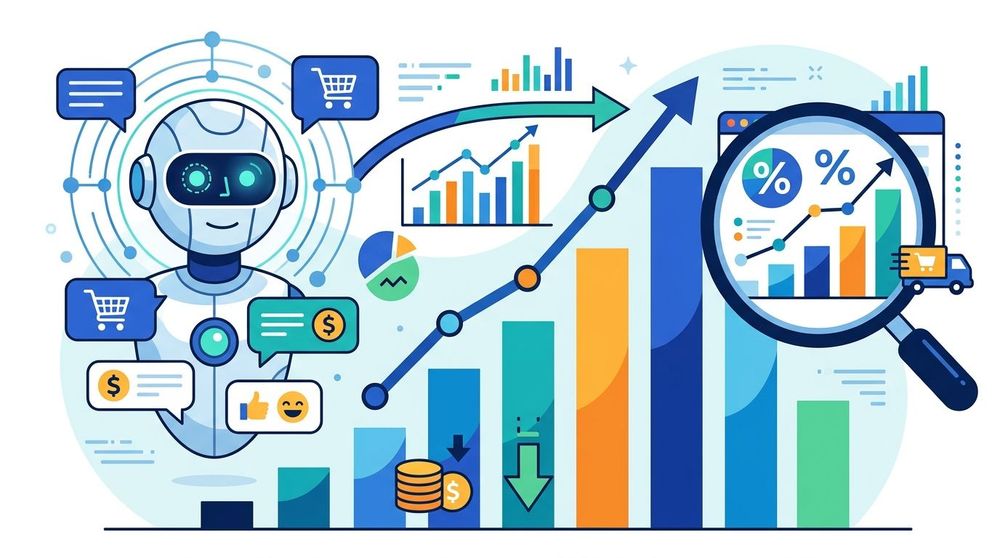
source: own elaboration
Introduction: From Tech Fascination to Hard Data
Implementing artificial intelligence in e-commerce has shifted from being a technological novelty to a strategic necessity. However, for e-shop owners and e-commerce managers, the key question remains: how to actually profit from this change? Understanding the Return on Investment (ROI) of AI tools requires going beyond a simple comparison of subscription costs to time savings. The true value lies in the synergy of budget protection, increasing conversions, and optimizing sales processes.
Pillar 1: Reducing Operational Costs with AI
The most direct way to measure ROI is by analyzing customer service costs. Solutions such as eSeller or AI Phone take over a significant portion of repetitive inquiries that previously required a team of consultants. An automated phone assistant conducting live calls 24/7 and an AI chat integrated with the product feed allow for handling thousands of customers simultaneously without the need to scale the support department.
To measure this metric, compare the monthly maintenance cost of the AI Agent with the cost of employee man-hours that would have been dedicated to the same tasks. It is also worth considering the value of lost sales opportunities that the AI saves by answering customer questions during night hours or on weekends.
Pillar 2: Increasing Conversions and Recovering Abandoned Carts
Another area generating high ROI is active sales support. Tools like Sales Bot operate proactively. They identify users who show high interest in the offer but, for some reason, hesitate to finalize the purchase. Through price profiling and offering individual discount codes at the key moment, the AI prevents the customer from switching to the competition.
Metrics to monitor:
- Conversion Rate (CR) for users interacting with the bot.
- Average Order Value (AOV) with AI product recommendations.
- Number of recovered sessions that would have ended in leaving the site without the bot's intervention.
Pillar 3: Marketing Spend Efficiency
Marketing automation is not just about saving time, but primarily about better utilization of the advertising budget. Ads Bot AI optimizes Performance Max campaigns by improving product feed quality and automatically generating creatives. We measure efficiency here through an increase in ROAS (Return on Ad Spend) and a decrease in CPC (Cost Per Click).
However, ROI also means avoiding waste. Tools like Click Scanner and Affiliate Scanner protect the budget against dishonest practices. Detecting bots, click farms, or cookie stuffing allows for real savings. Money that previously went to dishonest publishers or was wasted on empty clicks can be redirected to high-value traffic, which directly translates into higher profitability for the entire business.
How to Create an ROI Calculation Model for Your Company?
To reliably assess the effectiveness of an AI Agent, it is worth using a simple formula: ROI = (Profit from automation - Implementation and maintenance cost) / Implementation and maintenance cost * 100%.
"Profit from automation" consists of:
- The value of additional sales generated by the eSeller and Sales Bot.
- Advertising budget savings thanks to blocking fraud (Click Scanner).
- Reduction in customer service expenses (AI Phone).
- Profit resulting from higher campaign efficiency (Ads Bot AI).
Summary
Implementing an AI Agent in e-commerce is an investment that, with the right approach, pays off on many levels. The key to success is a holistic view of data – from protecting the budget against bots and intelligent ad optimization to automated service and sales. At TrafficWatchdog, we observe that companies choosing full integration of AI tools gain not only a technological advantage but, above all, a measurable improvement in financial results, becoming more resilient to dynamic market changes.