ROI from Sales Bot Implementation: How Conversion Automation Drives E-commerce Profitability
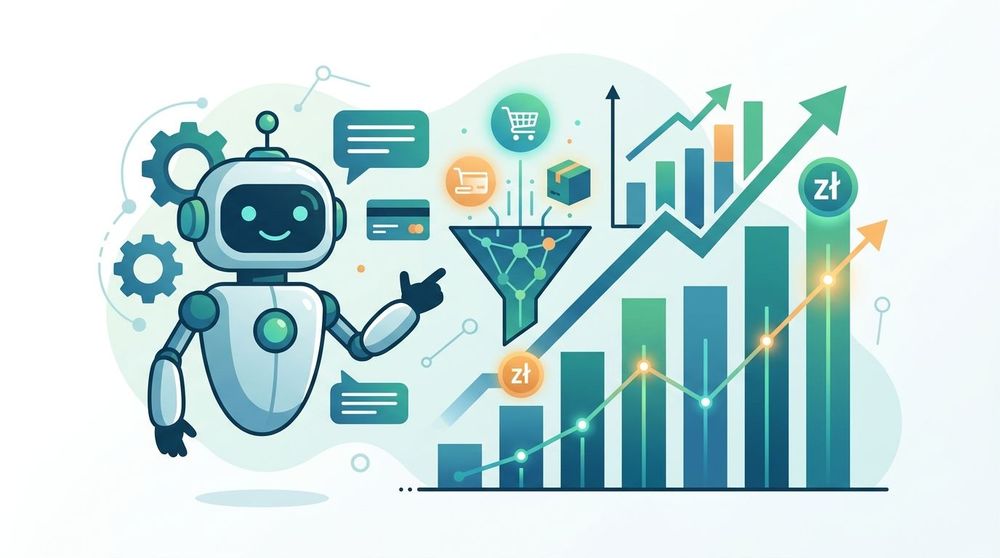
source: own elaboration
Modern e-commerce faces a paradox of abundance: acquiring traffic is becoming increasingly expensive, yet a significant portion of users leave the store without finalizing a purchase. Traditional methods of customer retention, such as static pop-ups asking for newsletter sign-ups, are becoming less effective. Users, accustomed to ubiquitous advertising messages, have developed a mechanism known as banner blindness. This is where the Sales Bot comes in—a solution that moves the discounting mechanism to the level of intelligent personalization and precise timing.
Why Companies Calculate ROI Before Implementing AI and Automation
The decision to implement new technologies in the B2B and e-commerce sectors is no longer based on a desire to be "innovative," but on hard financial data. According to a McKinsey report published in 2025, as many as 78% of B2B organizations declared using AI in at least one area, with the main driving force being a measurable return on investment (ROI). Companies analyze ROI because they want to avoid the "automation of chaos." As noted by Piotr Majkusiak, CEO of Luxio, implementing advanced tools on disorganized data will not yield results. The Sales Bot from TrafficWatchdog solves this problem by operating on rigid, predefined paths, allowing for precise prediction of costs and potential profits even before the system is fully launched.
| Criterion | No Automation | In-house IT Solution | This Product (Sales Bot) |
|---|---|---|---|
| Implementation Cost | $0 (high cost of lost opportunities) | Very high (CAPEX, dev-team) | Low (SaaS, from $50/mo) |
| Time to Launch | N/A | 3 to 12 months | Minutes (code snippet) |
| Technical Requirements | None | Server resources and architecture | Basic HTML/JS editing skills |
| Scalability | Zero (manual work) | Requires constant IT maintenance | Full (handles thousands of sessions) |
| Support | None | Internal (risk of staff turnover) | Full Customer Care support |
Sales Bot vs. Traditional Pop-up: What is the Difference?
A traditional pop-up is passive and often annoying. A Sales Bot is an interactive sales widget that identifies a user showing hesitation. The system monitors customer behavior—for example, it identifies people who visit the store for the third time but still have not made a transaction. Only at this critical moment does the bot activate a script-based conversation, offering an individual discount code and a product carousel tailored to the browsing history. This proactive approach changes the psychological dynamic from "being interrupted" to "receiving assistance." While a pop-up blocks the screen indiscriminately, the Sales Bot waits for behavioral triggers that suggest a high intent to purchase but a low final motivation. By addressing this specific gap, the tool directly impacts the Conversion Rate (CR) without damaging the user experience (UX).
Key Features Affecting ROI
- AI Pricing Profiling: This is one of the most important functions of the Sales Bot. Instead of giving discounts to everyone, the system divides users into three groups: high probability of purchase (low or no discount), medium, and low (higher discount). This ensures the store does not burn its margin where the customer would have made a purchase anyway.
- Individual Codes (CSV List): Unlike pop-ups with a static code, the Sales Bot can operate on unique one-time codes. This eliminates the risk of the code leaking to coupon portals and protects the marketing budget from unintended depletion.
- Google Ads Remarketing Integration: Users interacting with the bot are automatically added to dedicated remarketing lists. This allows for precise sales closing outside the store's website through highly targeted display ads that reference the specific interaction with the bot.
Key fact: According to the State of Sales 2025 Salesforce report, as many as 83% of sales teams using AI tools reported an increase in revenue, which is 1.3 times better than teams using traditional methods.
How the Sales Bot Identifies a Hesitant Customer
The conversion process begins with precise identification. The Sales Bot does not attack the user in the first second after they enter the site. Instead, it analyzes the profile of the customer who clicks on paid ads but shows hesitation. This is crucial for optimizing Customer Acquisition Cost (CAC). When a subsequent visit is detected (e.g., the third session of the same user), pricing profiling occurs. The system assesses whether a given customer needs an additional incentive in the form of a discount or if a proper product recommendation is sufficient. This approach allows for the recovery of traffic that the store has already paid for in Google Ads or Meta Ads systems, which without the bot's intervention would remain a dead cost. By calculating the value of these "lost" sessions, companies can see a clear path to a positive ROI within weeks of deployment.
Automated Sales Chat Without the Risk of Hallucinations
A key technological difference must be emphasized: the Sales Bot is not an AI chatbot in the sense of a Large Language Model (LLM). It is a widget operating on rigid, predefined paths. The user does not type their own questions but clicks on prepared options. Why is this important for ROI?
- Full control over communication: The bot will never promise a customer something that is not in the offer.
- Predictability: Every path leads to a specific sales goal, ensuring consistent brand messaging.
- Speed: The lack of a need for an AI model to "think" means immediate widget reactions, which is vital for maintaining user engagement on mobile devices.
The European Perspective: Law and Compliance
When implementing a Sales Bot in European Union markets, regulations such as the EU AI Act must be considered. The Sales Bot, operating on predefined paths, usually qualifies for the Limited Risk category. This implies a transparency obligation—the user must know they are talking to a bot, which TrafficWatchdog ensures through clear welcome message configuration. From a GDPR perspective, the Sales Bot bases its operation on the concept of "legitimate interest," which is key when personalizing offers in real-time. Unlike aggressive AI SDR systems, the Sales Bot operates inside the store's website, making it easier to manage consents and data security. This legal safety reduces the risk of potential fines, which should be factored into the long-term ROI calculation.
How to calculate ROI for your company?
To reliably assess the potential return on implementing a Sales Bot, follow these steps:
- Calculate the cost of lost sessions: Check Google Analytics to see how many users abandon their cart or leave the site after their 3rd visit without a purchase.
- Estimate the cost of manual discounting: How much time does your team spend generating and sending codes? Multiply this by the hourly rate.
- Apply the bot conversion rate: Make a conservative assumption of a 10-15% increase in conversion for the "hesitant" group.
- Compare with the package cost: The Starter Sales Bot package costs as little as $50 per month with a limit of 10,000 sessions. Compare this with the margin obtained from recovered customers.
Why a Sales Bot Instead of a Full AI E-Seller?
While an AI E-Seller offers free conversation, a Sales Bot is often a better choice for smaller stores or companies that fear so-called AI hallucinations. Because the Sales Bot uses fixed paths, every response is 100% predictable and consistent with brand policy. It is a cheaper solution, faster to implement, and focused solely on one goal: converting the hesitant. If a customer is looking for a real conversation, answers to complex questions about product composition or technical parameters—then an AI E-Seller is the right choice. The Sales Bot is a sales "closer," whose task is to provide a discount code and a product carousel at the moment of hesitation. This specialization allows for a much higher efficiency in direct sales tasks compared to general-purpose bots.
Upsell and Increasing Average Order Value (AOV)
The Sales Bot does not finish its work the moment a discount is granted. After the purchase of a main product, the bot can be configured to suggest complementary products (cross-selling) or more expensive alternatives (up-selling). Thanks to integration with the product feed (GMC or XML file), the product carousel is always up-to-date and matched to the store's stock levels. This functionality directly increases the Average Order Value (AOV), which is a key component of the overall ROI equation.
Key fact: The Median Time to ROI for ready-made sales automation solutions is currently approximately 5.2 months — source: luxio.biz market research 2024.
Summary
- Intelligent Discounting: The Sales Bot eliminates the problem of "giving away" margin thanks to optional AI profiling, which matches the discount amount to the probability of purchase.
- Traffic Recovery: The system focuses on users who have clicked on paid ads but hesitate before buying, which directly improves the ROAS of Google Ads and Facebook Ads campaigns.
- Security and Predictability: Thanks to predefined paths, the company has full control over communication, which is crucial in the context of EU AI Act regulations.
- Ecosystem Integration: The ability to send data to Google Ads and integration with the product feed (GMC/XML) makes the bot an integral part of the sales funnel.
- Low Entry Barrier: With prices starting from $50 per month, a return on investment is achievable with just a few recovered orders per month.
- Scalability: Unlike manual customer service, the bot can handle thousands of simultaneous sessions without additional costs, making it ideal for seasonal sales peaks like Black Friday.