4 Formats from 1 Idea: How AI Agents Scale Content for SEO, AI SEO, Social, and Video
source: own elaboration
The Content Scaling Challenge: Why One Format Is Not Enough in Modern E-commerce
Creating unique, high-value content has become the cornerstone of acquiring customers online. However, modern consumers do not limit themselves to a single channel. When searching for products, they use traditional search engines like Google, ask conversational assistants (such as ChatGPT or Perplexity), scroll through social media feeds, and watch short video content like Reels or TikToks. For e-commerce marketing departments and B2B managers, this presents a significant challenge: how can you maintain a consistent presence across all these touchpoints without multiplying your budget and hiring an army of copywriters?
According to data published in the Eurostat report on AI adoption in enterprises, in 2025 an average of 20% of companies in the European Union utilized artificial intelligence solutions. Regional leaders like Denmark (42%) and Finland (around 38%) clearly set the trend, while Central and Eastern European countries are accelerating their digitization processes. Global interest in autonomous technologies is skyrocketing — the AI agents market forecast by MarketsandMarkets estimates the sector to grow from $7.84 billion in 2025 to over $52 billion by 2030.
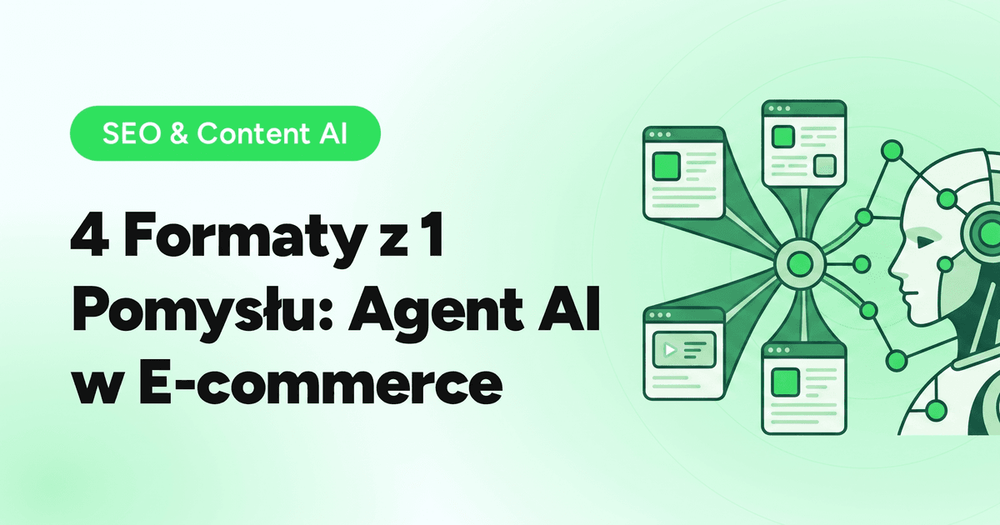
The solution to content production bottlenecks lies in multi-channel content repurposing powered by a Dedicated AI Agent. Instead of crafting every piece of media from scratch, a modern AI system takes a single core idea or product and converts it into four cohesive formats: a rich blog article for SEO, structured answers for AI SEO (GEO/SGE), social media posts, and short-form video scripts.
Key Fact: The use of advanced artificial intelligence agents in marketing automation can reduce multi-channel content campaign creation time by up to 91%, while maintaining high search engine rankings — according to research by AgentDock AI Research.
What Is a Dedicated Content AI Agent and How Does It Work in Practice?
Most marketers associate content generation with passive language tools that require constant prompt engineering and yield repetitive, generic text. A Dedicated AI Agent (such as the Blog AI Agent by TrafficWatchdog) operates on an agentic execution model (Agentic AI). This means it enjoys autonomy in achieving business objectives:
- Real-time Web Search Data: The Agent does not rely solely on frozen model weights. Before drafting text, it scans the web to verify current prices, market data, specifications, and customer reviews, effectively eliminating AI hallucinations.
- Product Catalog Integration: The system integrates directly with the store inventory (via Google Merchant Center, XML feeds, or APIs for platforms such as WooCommerce, Shoper, IdoSell, PrestaShop, or Shopify). Consequently, it automatically embeds direct links to specific products from the seller's offering directly into the text.
- Structured Multi-Channel Workflow: From a single buyer intent (e.g., "how to choose an espresso machine for a small office"), the Agent automatically generates a comprehensive package of materials tailored for every customer touchpoint.
As shown by cost analyses by Negre Florian, deploying vertical AI agents for repetitive operational processes allows European enterprises to lower unit costs of data processing and creative output by an average of 67%.
4 Formats from 1 Idea: Architecture of Multi-Channel Distribution
Let us explore how a single product concept or guide idea is transformed by an AI Agent into four distinct formats, each serving a dedicated role in the sales funnel.
Format 1: Blog Article for Traditional SEO (Long-Form Content)
A detailed guide, ranking, or product comparison optimized for Google search algorithms. The Agent creates content targeting long-tail keywords, structures headings properly (H2, H3), and places contextual links to product pages within the store.
- Example: An article titled "Top 5 Espresso Machines for Small Offices in 2025 — Ranking & Comparison".
- Business Goal: Capture organic traffic searching for commercial knowledge and route users directly to relevant store product pages.
Format 2: AI SEO / GEO (Generative Engine Optimization)
An increasing number of users request recommendations directly inside ChatGPT, Perplexity, or Google Gemini. These LLMs do not read walls of unstructured text — they look for concise, authoritative, and well-structured facts.
- Example: An information capsule styled as an HTML table and bulleted summary highlighting key technical parameters, advantages, and pricing, implemented via structured site code (schema.org / FAQ).
- Business Goal: Ensure your brand is cited as a recommended source by conversational AI engines.
Format 3: Social Media Posts (Social Media Content)
Blog content is automatically condensed into engaging posts tailored for platforms like LinkedIn, Facebook, or Instagram. The Agent extracts the core takeaway, crafts a compelling hook, and adds a clear call to action (CTA).
- Example: "Is it worth spending extra on a commercial coffee machine for your team? We tested 5 models for reliability and cost per cup. Here are the main takeaways... [Link]".
- Business Goal: Build organic reach and drive qualified social media traffic back to the storefront.
Format 4: Short-Form Video Scripts (TikTok / Instagram Reels / YouTube Shorts)
Video remains the most engaging content format online. The Agent delivers a production-ready 30–60 second video script complete with voiceover lines, recommended B-roll shots, and text overlays for screen placement.
- Example: Script concept: "3 mistakes when picking an office coffee machine. Mistake #1: Ignoring the size of the coffee grounds container...".
- Business Goal: Capture the attention of younger demographics and expand brand awareness.
Key Fact: According to market analyses discussed in the Coseom publication on B2B trends, Gartner predicts that by the end of 2026, 40% of enterprise applications will feature embedded autonomous AI agents.
Comparison: Manual Content Creation vs Dedicated AI Agent
The table below details the operational and financial differences between traditional manual content workflows and using an automated AI Agent.
| Feature / Parameter |
We will design and implement your AI automationTell us what your company needs, and we will choose the right AI tools. Hello! |
|---|