AI Sales Assistant vs. Traditional Chat: Cost and Efficiency Comparison in E-commerce
source: own elaboration
Introduction: A New Era of Customer Service in E-commerce
In an era of rapid technological development, online store owners face a key dilemma: how to scale customer service without generating exorbitant operating costs? Traditional solutions based on human labor, though valued for empathy, are increasingly giving way to advanced automation. Tools such as the AI Sales Assistant from TrafficWatchdog are redefining how brands communicate with consumers, offering efficiency unattainable for classic service offices.
Operating Costs: Human Labor vs. Algorithms
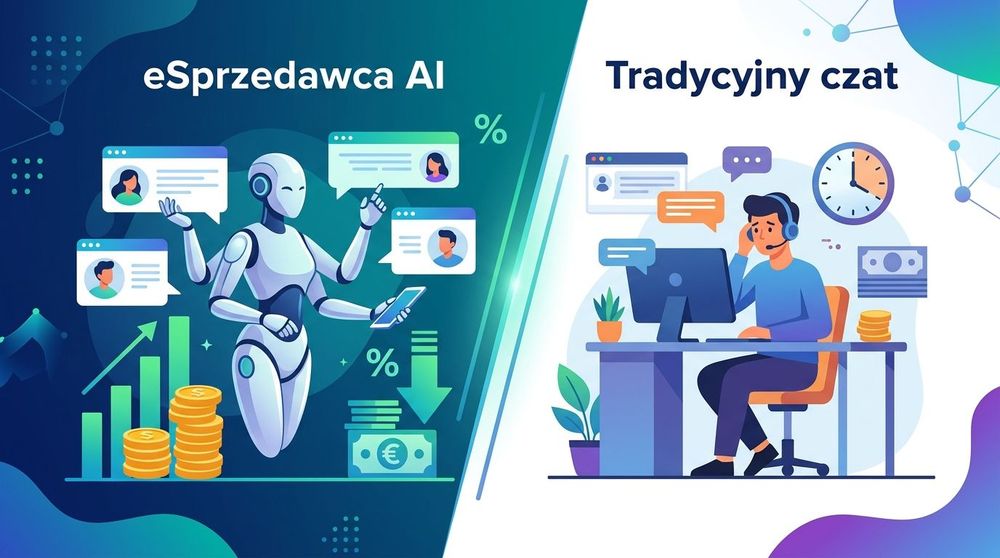
Traditional chat requires hiring qualified consultants. These costs include not only salaries but also recruitment, training, office infrastructure, and bonuses for night or weekend shifts. Moreover, human efficiency has its limits – one consultant can handle a limited number of conversations simultaneously without a drop in service quality.
Implementing the AI Sales Assistant changes this cost model to a fixed and predictable one. The system does not require breaks, does not get sick, and is ready to handle thousands of inquiries at the same time. Thanks to integration with the product feed, the AI has instant knowledge of stock levels and product specifications, eliminating the time a human needs to check data manually.
Efficiency and 24/7 Availability
Today's consumer shops at various times, often expecting an immediate response to questions about a product or order status. Traditional chat often ends work at 5:00 PM, which leaves evening customers without support and frequently results in cart abandonment.
The AI Sales Assistant operates continuously. It not only answers questions but actively supports the purchasing process by:
- Recommending products tailored to the customer's needs.
- Providing information in multiple languages, opening the store to international markets.
- Generating individual discount codes that close sales at the key moment.
Conversion: From Answer to Sale
The main difference between traditional chat and an intelligent AI Sales Assistant is goal orientation. While a consultant often focuses on solving a problem (reactivity), TrafficWatchdog's AI is designed to sell (proactivity). By analyzing user behavior, the system can identify a moment of hesitation and propose a solution that convinces the customer to finalize the transaction.
Collaboration with other tools, such as the Sales Bot, allows for even deeper personalization. If the system detects that a user returns to a product but does not buy it due to price, the AI Sales Assistant can automatically propose a dedicated discount, effectively preventing the customer from leaving for the competition.
Summary: Which Solution to Choose?
While traditional chat can be useful in very complex, non-standard complaint cases, in everyday e-commerce service, AI takes over as the efficiency leader. Investing in an AI Sales Assistant is not only a budget saving but, above all, an investment in business scalability. Combined with tools like Ads Bot AI, which optimizes traffic coming to the store, intelligent chat becomes a sales closer that works for the company's profit around the clock.