Case Study: How AI eSeller Turns 15% of Conversations into Paid Orders
source: own elaboration
The European e-commerce market has reached a critical turning point. Rising customer acquisition costs (CAC) across Google Ads and Meta Ads channels mean that the traditional strategy of simply pouring more budget into paid traffic no longer guarantees profitability. The average conversion rate across most online stores rarely exceeds 2-3%, which means that as many as 97 out of 100 visitors leave the website without completing a purchase. A substantial share of these potential customers abandon their shopping journey for a remarkably simple reason: the lack of an immediate answer to questions regarding product specifications, compatibility, shipping times, or size availability.
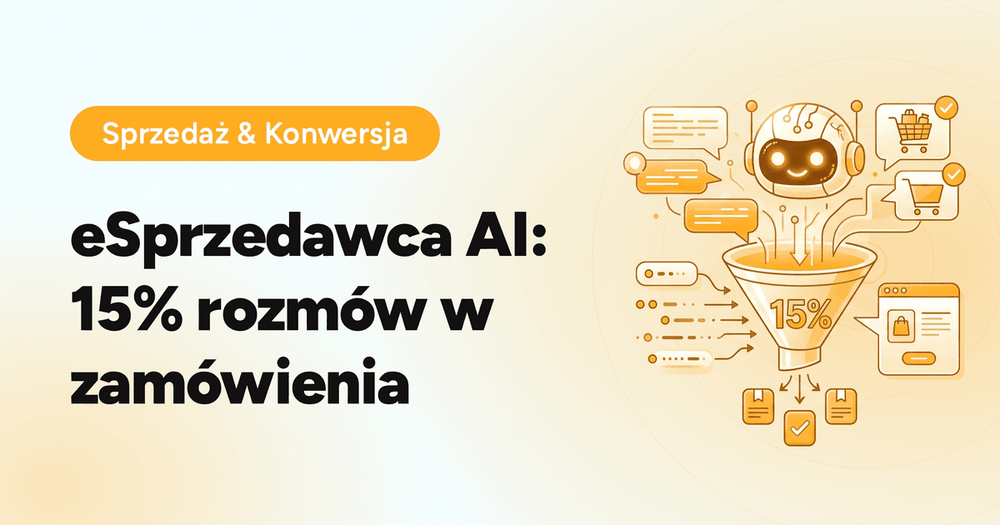
The strategic answer to this operational gap is next-generation conversational automation. In contrast to legacy rule-based bots, modern generative models can serve as fully autonomous digital sales consultants. The AI eSeller tool from TrafficWatchdog demonstrates that a virtual sales advisor, precisely grounded in an online store's catalog, can convert an average of 15% of engaged conversations into directly paid orders.
Market Context: The Conversational Commerce Revolution in Europe
The shift from passive online storefronts to active conversational commerce is an ongoing Europe-wide transformation. According to findings published in the Salesforce State of Sales 2026 report, 87% of global sales organizations have implemented artificial intelligence tools to directly support transaction workflows. Furthermore, according to the Gartner Sales Technology Report, the adoption rate of intelligent sales systems among revenue-focused enterprises surged from 34% in 2023 to nearly 89% by 2025.
The decisive factor in closing transactions online is response latency. In modern digital retail, buyers refuse to wait hours for an email reply.
Key fact: According to data published by Forrester Research, reaching out to a prospective buyer within under 5 minutes increases conversion probability by up to 21 times, whereas the likelihood of closing a sale drops dramatically after just the first 24 hours of delay.
Across European Union markets, the pace of large language model adoption shows fascinating dynamics. In Germany and the Nordic region, enterprises are aggressively deploying autonomous agents across both B2B and B2C supply chains Globeria Consulting. In Poland, research conducted by OVHcloud and PMR reveals that while 83% of business managers view AI as a strategic technology, 47% still linger in an observational phase. Meanwhile, consumer expectations are advancing rapidly: a report by the Chamber of Digital Economy on the B2B Customer Journey indicates that up to 94% of business buyers already consult AI algorithms when evaluating and selecting commercial offerings. Turnkey AI-as-a-Service solutions now serve as the bridge that eliminates this technical barrier without requiring massive capital investments in internal data science teams.
Why Traditional Chatbots Failed While AI eSeller Converts
Many e-commerce leaders view on-site chat widgets with skepticism, colored by their past experiences with earlier technologies. Traditional chatbots relied on two rigid architectures: static decision trees (where users could only click predefined buttons) or rudimentary keyword matching. A single typo, a compound question, or a request to compare two models was enough to trigger a helpless fallback message: "I am sorry, I did not understand your question. Please contact our support team."
AI eSeller represents a fundamental technological departure. It is powered by state-of-the-art language models (leveraging the latest Google Gemini engine or alternative frontier models from providers such as OpenAI GPT or Anthropic Claude) enriched with real-time, domain-specific data from your online store. Rather than guessing keywords, the agent grasps natural language intent, reasons across technical parameters, and conducts a fluid advisory dialogue.
| Feature / Capability | Legacy Chatbots | AI eSeller (TrafficWatchdog) |
|---|---|---|
| Communication Model | Rigid scripts, button clicking, exact keyword matching | Fluid natural language dialogue, deep contextual reasoning |
| Product Catalog Access | Manually hardcoded links to a handful of selected landing pages | Dynamic sync with Google Merchant Center, XML product feed, or direct API |
| Product Recommendations | None or generic, randomized promotional banners | Context-aware recommendations with real-time images, prices, and direct add-to-cart buttons |
| Discount Policy | None, or static coupon codes blast-displayed to everyone | Intelligent, intent-triggered discounts offered exclusively to hesitating shoppers |
| Multilingual Support | Requires costly, separate script configurations for each language | Native out-of-the-box multilingual capabilities (automatically adapting to the shopper) |
Who Benefits Most from This Solution?
AI eSeller is not restricted to a narrow niche of online stores. It excels across any vertical where customer purchasing decisions demand advisory assistance or where a sprawling catalog overwhelms prospective buyers.
| Industry / Segment | Typical Business Challenge | Key Advantage of AI eSeller |
|---|---|---|
| Consumer Electronics, Appliances, IT | Complex technical specifications, difficulty identifying compatible accessories | Precise multi-parameter filtering matched to shopper needs and automated cross-selling |
| Home, Garden & DIY Construction | High average order value; customers fear making mistakes in sizing, dimensions, or installation | Step-by-step guidance verifying technical specs directly from product datasheets and PDF guides |
| Fashion, Footwear & Beauty | Elevated cart abandonment rates, repetitive queries regarding sizing charts, ingredients, and returns | Instant resolution of return policy inquiries and proactive outfit/styling recommendations |
| B2B Wholesale & Industrial Distributors | Repetitive quote requests, queries on stock availability and tiered pricing structures | Relieving sales reps from routine support tickets and qualifying international buyers 24/7 |
Anatomy of Success: How AI eSeller Turns 15% of Chats into Completed Orders
Achieving an average 15% conversion rate from live conversations is not a matter of luck. It is the result of four coordinated behavioral modules operating in unison:
1. Active Sales Guidance Driven by Live Product Feeds
Rather than directing shoppers back to an impersonal search bar, AI eSeller parses your store's entire catalog (synchronized via Google Merchant Center, XML feeds, or direct store APIs). When a shopper asks: "I need a cordless lawn mower for a 400 sqm lawn with a mulching function under 350 EUR", the assistant queries the database in milliseconds, filters products by strict criteria, and returns curated recommendations complete with product photography, pricing, and direct checkout links. This reduces purchase friction to zero.
2. Capturing After-Hours and Weekend Traffic
Between 40% and 50% of e-commerce traffic occurs during evenings, weekends, and holidays—precisely when human customer care agents are off duty. A customer who receives no assistance at 10:00 PM will likely return to search results and purchase from a competitor. AI eSeller operates 24/7/365, delivering an uncompromised standard of consultation around the clock.
3. Dynamic Closing and Conditional Discounts
The platform features behavioral algorithms designed to detect hesitation patterns. If a user repeatedly inquiries about alternative items, lingers on a product page, or returns to the store multiple times, the AI assistant can step in strategically: "I notice you are considering this specific model. If you decide to order today, here is an exclusive coupon code for 5% off." This calculated intervention effectively rescues at-risk carts.
4. Intelligent Upselling and Post-Purchase Care
When a shopper adds a product to their cart or completes a purchase, AI eSeller can suggest complementary items (such as dedicated mower oil, extra batteries, or replacement blades). Furthermore, when connected with your order management system, the assistant automates repetitive shipment tracking inquiries ("Where is my package?"), liberating your helpdesk from routine overhead.
Key fact: According to analyses by Harvard Business Review, enterprises deploying high-precision conversational AI in sales processes achieve an average return on investment (ROI) between 300% and 700%, establishing autonomous sales agents among the most lucrative technological investments in modern commerce.
Step-by-Step: Implementing AI eSeller
Store owners frequently worry that deploying advanced generative AI requires months of custom coding and hefty development retainers. TrafficWatchdog has streamlined this onboarding down to just a few business days without requiring internal IT resources.
[TrafficWatchdog Sign-up] ──► [Data Source Connection] ──► [Widget Code Embedded] ──► [Knowledge Base Setup] ──► [14-Day Free Pilot] ──► [Full Production Launch]
Step 1: Registration and Data Source Audit
The process begins with account creation inside the TrafficWatchdog portal (panel.trafficwatchdog.pl/pl) and consultation with a dedicated account manager. The store selects its product data source. The recommended method is granting access to Google Merchant Center (GMC)—utilizing standard Google authorization protocols that remain secure and revocable at any time. Alternatively, merchants can supply an XML product feed (standard for WooCommerce, Shopify, PrestaShop, or custom carts) or connect directly via API.
Step 2: Knowledge Base Configuration
The TrafficWatchdog technical team builds the general knowledge base for the agent. Core store pages are ingested: terms of service, shipping policies, payment methods, returns and claims procedures, sizing tables, and FAQ repositories. Store owners can also upload custom PDF guides or documentation detailing product lines and internal guidelines. In the Starter tier, the assistant ingests up to 15 pages and 15 documents (supporting up to 10,000 products); in the Growth tier, up to 25 pages/documents (up to 25,000 products); and in the Pro tier, up to 50 pages/documents (up to 50,000 products).
Step 3: On-Site Widget Installation
Embedding the chat widget is remarkably simple:
- For platforms like WooCommerce (WordPress): Fast integration is available through official repository plugins.
- For Shopify, Magento, PrestaShop, and custom platforms: A single line of JavaScript code embedded into the header is all that is required.
- If needed, the TrafficWatchdog integration team handles script installation directly at no extra charge.
Step 4: Staging Testing and Verification (14-Day Free Trial)
Once the knowledge base has been indexed by our engineers (typically taking 1-2 business days), the client receives a dedicated demonstration environment. Store owners enjoy 14 days of free testing on actual product queries before committing to a paid subscription.
Step 5: Production Rollout and Conversion Analytics
Following production launch, store management receives automated daily email performance summaries tracking conversational volume and attributed sales conversions. Furthermore, AI eSeller transmits custom twd_eseller_msg_sent events to Google Analytics, enabling complete attribution within Google Analytics 4 (GA4). If an organization also faces heavy telephone or email volumes, the ecosystem easily expands with AI Email Generator (providing automated draft replies) or AI Voice Agent (a 24/7 conversational phone representative powered by the identical product knowledge base).
Regulatory Compliance: GDPR and the EU AI Act
The acceleration of commercial artificial intelligence in Europe demands rigorous alignment with European regulatory frameworks. Merchants operating within the EU must satisfy both the General Data Protection Regulation (GDPR) and the progressively enacted European Union AI Act.
According to legal analyses on European AI regulation, digital sales assistants are classified as minimal/low-risk AI systems. They do not fall under the strict prohibitions or burdensome conformity certifications designated for high-risk systems (such as automated recruiting or biometric profiling algorithms). The primary requirement imposed by the EU AI Act on online retail conversational agents is transparency: shoppers must be informed upon initial contact that they are interacting with an artificial intelligence system. AI eSeller fulfills this obligation automatically within its greeting screen.
Regarding GDPR compliance, the conversational assistant operates under the controller's legitimate commercial interest (Article 6(1)(f) GDPR) when providing prospective product guidance. In scenarios where personal information is collected for order tracking or returns, data processing is governed by standard Data Processing Agreements (DPA) between the merchant and TrafficWatchdog. Crucially, the models underlying AI eSeller do not train public foundational models on proprietary customer queries, safeguarding sensitive business information.
Frequently Asked Questions & Merchant Objections (FAQ)
-
"Could the AI hallucinate incorrect prices or invent unauthorized discounts?" AI eSeller relies on Retrieval-Augmented Generation (RAG) tied directly to your validated product feed. It answers exclusively with prices, coupon codes, and attributes present in the connected catalog. The assistant cannot independently fabricate an unauthorized 80% discount unless such promotion is explicitly established within your business logic.
-
"Can malicious users manipulate the bot through prompt injection?" Modern generative engines feature multi-tiered defensive barriers against jailbreak attempts and adversarial prompt injections. AI eSeller adheres to strict system prompts: it politely declines irrelevant, political, or contentious inquiries and steers conversations back to your catalog.
-
"What occurs if our store reaches the monthly conversation quota?" TrafficWatchdog maintains transparent quotas (Starter: 250 conversations, Growth: 500, Pro: 1,000; with a conversation defined as up to 20 dialogue turns lasting up to 15 minutes from the last message). When a quota is reached, the widget pauses gracefully until the next billing cycle, or the merchant can seamlessly upgrade tiers through their account manager. No unexpected overage fees are ever charged.
-
"Can the assistant handle complex return disputes or escalations?" AI eSeller is not designed to eliminate human support staff. In intricate claim scenarios, the assistant smoothly provides direct contact channels (hotline phone numbers or support email addresses) or collects the customer's phone number to automatically create an internal escalation ticket for human specialists.
-
"How quickly does the platform generate a positive return on investment?" Given the accessible cost of the Starter plan, in most retail sectors just 1 or 2 rescued orders per month cover the entire tool subscription. For e-commerce stores with steady inbound traffic, converting an average of 15% of chats into completed orders yields ROI multiples that dwarf operational expenses.
Implementation Roadmap
| Phase | Duration | Key Deliverables | Stakeholders Involved |
|---|---|---|---|
| 1. Audit & Requirements Discovery | 1–2 business days | Evaluating knowledge resources, product catalog scope, discount boundaries, and defining essential conversational flows. | E-commerce Director, TrafficWatchdog Team |
| 2. Data Feed & API Integration | 2–3 business days | Synchronizing the product catalog (prices, images, specifications), configuring semantic search, and connecting optional order lookups. | Store IT Specialists, TrafficWatchdog Engineers |
| 3. Brand Voice & Prompt Calibration | 1–2 business days | Refining brand tone of voice, setting recommendation priority rules, and formulating dynamic incentive thresholds for returning users. | Customer Care Lead, AI Prompt Specialist |
| 4. Quality Assurance & Pilot Testing (UAT) | 2 business days | Simulating complex purchasing journeys, validating URL destinations and live stock prices, and stress-testing edge cases. | Customer Success Team, TrafficWatchdog QA |
| 5. Production Go-Live & Optimization | Go-live day + continuous tracking | Publishing the AI eSeller widget live on the storefront, tracking conversational attribution in GA4, and refining dialogues 24/7. | E-commerce Manager, TrafficWatchdog Account Lead |
Summary
The maturation of large language models between 2024 and 2026 has decisively ended the era of frustrating, script-bound chatbots that drove potential buyers away. Cutting-edge solutions such as AI eSeller show that conversational intelligence is the most reliable lever for boosting digital retail profitability without swelling advertising spend.
- Measurable Conversion Performance: An average of 15% of substantive dialogues handled by AI eSeller culminate in a completed order through real-time advisory guidance.
- Uninterrupted 24/7 Availability: The assistant captures high-intent traffic during peak evening and weekend browsing hours when traditional helpdesks are inactive.
- Effortless Implementation: Connecting catalog feeds via Google Merchant Center, XML streams, or platform APIs takes only 1–2 business days with full support from TrafficWatchdog.
- Integrated Intelligent Ecosystem: AI eSeller connects smoothly with complementary capabilities, such as AI Email Generator for automated inbox replies and AI Voice Agent for phone support.
- Risk-Free Adoption and EU Compliance: A 14-day free pilot period, transparent pricing, and comprehensive adherence to GDPR and EU AI Act mandates ensure an effortless upgrade for any growing digital merchant.