Cost of Adding 1000 Products: Traditional Model vs AI Agent in E-commerce
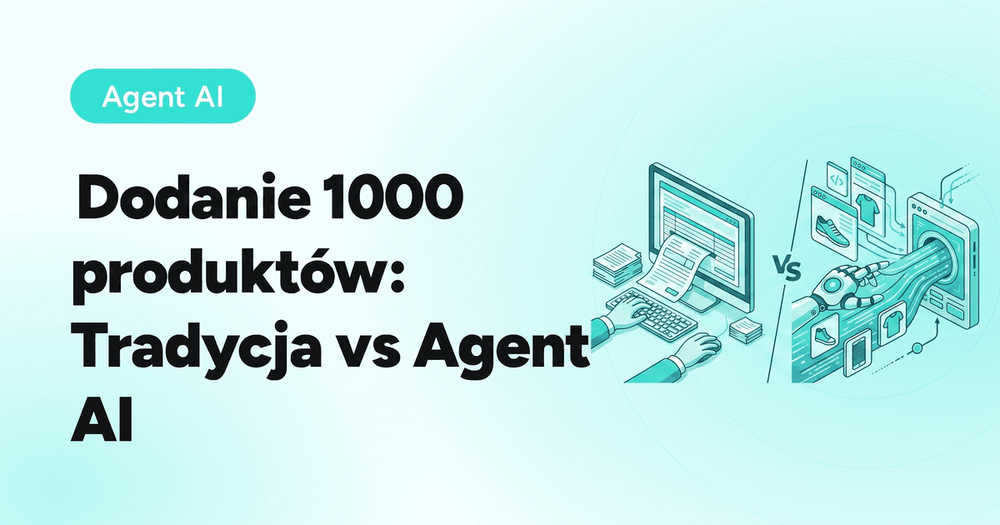
source: own elaboration
E-commerce ROI Analysis: Why Calculating Return on Investment Before Implementing AI Is Crucial
Modern e-commerce has evolved to a point where market advantage is determined not only by the attractiveness of the offer or the size of the advertising budget, but above all by operational efficiency. Introducing new product lines, expanding the catalog with new brands, or quickly responding to stock level changes from wholesalers are daily challenges for online store managers. One of the most repetitive and capital-intensive tasks in electronic commerce remains the process of adding and updating product cards.
Entrepreneurs across Europe are increasingly analyzing return on investment (ROI) before deciding on automation. This stems from the fact that blindly implementing technology without a clear business plan carries the risk of generating unnecessary technical debt. An accurate ROI calculation allows you to juxtapose direct labor costs, hidden operational losses, and conversion growth potential against the real cost of modern tools, such as a dedicated Product Management AI Agent.
Key fact: According to data published in the Eurostat Artificial Intelligence Statistics research, a "two-speed" market is visible in Europe — while nearly 55% of large enterprises already use artificial intelligence solutions, this figure stands at only around 17% in the SME sector, creating a massive opportunity for smaller entities to build a competitive advantage.
Adding 1000 new products to an online store is an ideal test case for comparing the traditional, manual work model with an artificial intelligence-based solution.
Cost Duel: Adding 1000 Products in the Traditional Model vs AI Agent
When calculating the traditional product implementation model, one must consider the working time of employees or an external agency: searching for specifications, translating and editing unique descriptions, downloading and processing images, assigning tags, attributes, categories, and manually filling in tables within the store's CMS system. Assuming a conservative estimate that preparing one complete product card takes a specialist an average of 20–25 minutes, manually entering 1000 products requires anywhere from 330 to over 400 hours of continuous work.
Conversely, a dedicated Product Management AI Agent (which is a specific variant of the Corporate AI Agent solution from TrafficWatchdog) automates this process at its core — it can generate complete cards based solely on barcodes (EAN/UPC/ISBN) or process unstructured files from suppliers in a fraction of that time.
The table below presents a detailed comparison of both models broken down by key operational categories:
| Savings Category / Parameter | Traditional Manual Model (Human / Agency) | AI Agent Model (Product Management AI Agent) |
|---|---|---|
| Completion Time (1000 products) | 330 – 400 hours (approx. 2–3 months of part-time work) | From 24 to 48 hours (fully automatic or assisted mode) |
| Estimated Direct Cost | 15,000 – 25,000 PLN (specialist / copywriting agency rate) | One-time setup + fraction of fixed AI Agent subscription |
| Risk of Errors and Typos | High (routine fatigue, mistakes in EAN, weights, and variants) | Negligible (algorithmic validation and file exception reporting) |
| Stock and Price Updates | Manual, irregular (often once a week or less) | Automatic (daily, every few hours, or in real time) |
| Canceled Orders (Out of Stock) | Frequent (selling products unavailable at the supplier) | Drop in stock-out cancellations to nearly zero |
| Impact on Conversion and SEO | Uneven description quality, slow launch of new arrivals | Rapid launch of new arrivals, SEO-friendly unique descriptions, full attributes |
Key fact: As shown by analyses published in the Globeria Consulting AI Agents ROI Analysis report, implementations of dedicated AI agents for data operations automation generate an average return on investment (ROI) exceeding 300% in the first year of operation, reducing the unit cost of traditional handling from over a dozen EUR down to fractional values.
The Impact of an AI Agent on Key E-commerce Business Areas
Moving from general financial calculations to the mechanics of an optimized e-commerce backend, it is worth analyzing how the Product Management AI Agent from TrafficWatchdog influences individual operational pillars of a business.
1. Time and Operational Efficiency: From Weeks of Tedious Work to a Few Minutes
Manually processing Excel spreadsheets from suppliers is a common pain point for e-commerce teams. Wholesalers send price lists in a wide variety of formats — from unformatted CSV files and non-standard XML structures to PDF documents or data available exclusively inside closed B2B portals.
A human specialist spends long hours aligning columns, converting currencies, or mapping tags. The AI Agent eliminates this bottleneck: it automatically retrieves data from any source (FTP, email, files, supplier website), reads it, normalizes structures, and uploads it to the store. Furthermore, this solution does not replace employees, but frees up their time. Instead of performing mechanical data entry, an e-commerce manager can focus on creating promotions, pricing strategies, or UX optimization.
2. Revenue Protection and Elimination of Hidden Costs (Canceled Orders)
One of the most underestimated costs in e-commerce is the cost of product unavailability. When a store sells a product that the wholesaler or manufacturer no longer has in stock, a so-called silent loss occurs:
- The store incurs non-refundable transaction fees from payment processors (e.g., Stripe, PayPal).
- The customer service team spends time contacting the disappointed buyer and processing the refund.
- The store loses the advertising budget spent on acquiring that user through Google Ads or Facebook Ads.
- The buyer loses trust in the brand and turns to competitors, often leaving a negative review.
The Product Management AI Agent solves this problem through continuous synchronization. When an item disappears from the supplier's warehouse, the agent immediately updates its status in the store — setting stock to zero, hiding the product card, or automatically deactivating it based on client preferences.
3. Catalog Scaling and Conversion Rate Optimization
E-commerce enterprises grow by scaling their catalog. In a traditional model, adding 2000 products from a new wholesaler requires hiring additional staff or putting the launch of a new category on hold for several weeks. With an AI Agent, this process boils down to providing a list of EAN/UPC codes or connecting a new supplier file.
Moreover, properly prepared product cards — complete with full technical specifications, accurate weights, dimensions, appropriate tags, and attractive, unique descriptions — directly increase conversion rates and boost organic performance in search engine results (SEO).
Practical Operation of the Product Management AI Agent from TrafficWatchdog
The system developed by TrafficWatchdog is built on advanced agentic technology and designed for ease of implementation. It operates in two main scenarios:
Automatic Synchronization of Stock and Prices from Multiple Suppliers
If a store offers an inventory from dozens of manufacturers, each sending updates in a different format (e.g., 3 Excel files, 2 XML files, emails with PDF attachments, and a B2B panel requiring login), the agent acts as a smart integrator:
- Retrieval: Periodically reads data from all sources.
- Normalization: Converts data into a standardized structure, correcting formats and units.
- Verification: Compares stock levels against the store's current database.
- Update: Overwrites prices, stock, and availability while deactivating discontinued items.
- Reporting: Delivers a clear summary report of changes made and exceptions detected to the owner.
Generating Complete Product Cards Solely from EAN/UPC Barcodes
In scenarios where a store acquires an offer from a wholesaler and only possesses a list of barcodes, the agent:
- Queries multiple product databases (including Open Food Facts, UPC Item DB, Google Shopping, and official manufacturer websites).
- Aggregates names, specifications, descriptions, images, dimensions, and attributes.
- Classifies products into appropriate categories within the store.
- Generates a ready-to-import file or directly uploads products via the store's API.
Integration with E-commerce Platforms and Flexible Operating Modes
The agent adapts to the client's infrastructure. It integrates seamlessly with most popular e-commerce platforms, such as Shoper, WooCommerce, PrestaShop, Shopify, IdoSell, or Magento, utilizing native REST APIs or data exchange files (CSV, XML).
It can operate in two modes:
- Fully Automatic Mode: Changes are applied seamlessly in the background according to a scheduled timetable.
- Assisted (Supervised) Mode: The agent prepares a proposed import file or change preview for one-click approval by a human manager, providing total control during initial deployment.
Legal Framework and EU Compliance: AI Act, GDPR, and Data Hygiene
Deploying autonomous AI agents in European e-commerce requires adherence to existing legal regulations. In accordance with the EU AI Act, businesses utilizing artificial intelligence are obligated to maintain appropriate standards of transparency and foster team AI literacy.
Furthermore, guidelines from the European Data Protection Supervisor (EDPS Orientations on Generative AI) emphasize the necessity of oversight in Automated Decision-Making (ADM) and personal data protection under GDPR. When automatically collecting web content and images, it is also essential to verify copyright ownership for photography supplied by manufacturers.
How to Calculate ROI from Implementing an AI Agent for Your Business?
Calculating the return on investment for your own online store can be performed in five simple steps:
-
Calculate human labor costs: Sum up the total hours your team spends monthly creating product cards, downloading price lists, and manually updating stock in Excel. Multiply this number by the gross hourly rate of your employees or agency.
-
Estimate losses from canceled orders: Check your store analytics to see how many orders in the last quarter were canceled due to supplier stock-outs. Sum up the lost profit margin and non-refundable payment processing fees.
-
Determine AI Agent implementation costs: For TrafficWatchdog solutions, such as the Corporate AI Agent or dedicated Product Management AI Agent, costs consist of a one-time onboarding fee and a fixed monthly subscription (e.g., packages starting from 2,500 PLN/month depending on database scale and source count).
-
Apply the ROI formula:
ROI = ((Operational Savings + Protected Lost Margin - AI Agent Cost) / AI Agent Cost) * 100%
-
Evaluate added value: Include indirect benefits such as reduced cart abandonment, higher Google rankings from unique descriptions, and the ability to instantly launch thousands of new items without hiring additional staff.