1000 Products per Hour: How an AI Agent Automates Inventory Onboarding
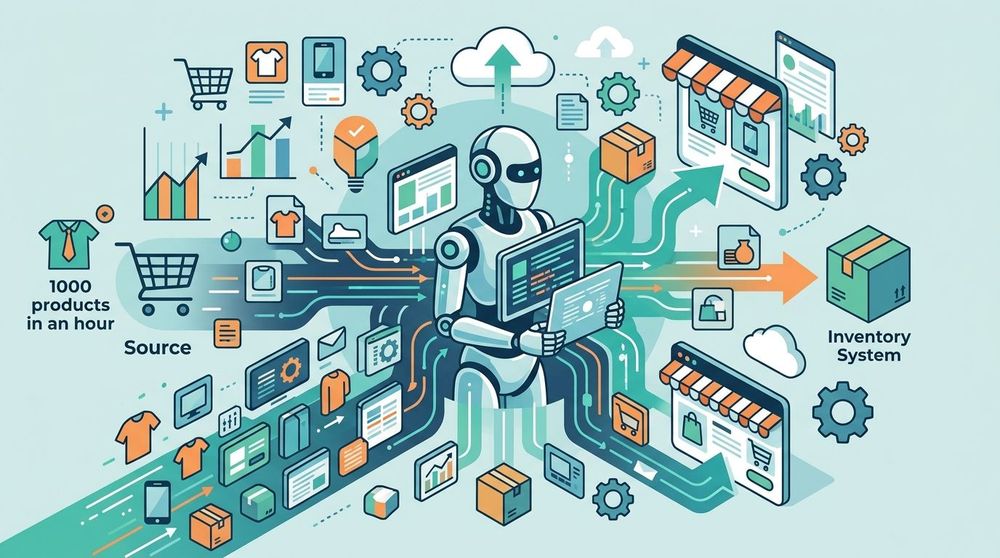
source: own elaboration
The Evolution of Catalog Management: From Excel Sheets to Autonomous AI Agents
Scaling inventory in modern e-commerce is one of the biggest growth drivers, but also one of the most painful operational bottlenecks. Adding hundreds of new products, mapping incompatible files from a dozen suppliers, or manually rewriting technical specifications is tedious, error-prone, and generates huge fixed costs.
Most mature markets in Europe are currently undergoing a fundamental technological transformation. Traditional, reactive chatbots and simple integration scripts are being replaced by fully autonomous Dedicated AI Agents (Agentic AI). According to a report by research firm MarketsandMarkets, the global market for AI agent-based solutions is expected to grow from USD 7.84 billion in 2025 to as much as USD 52.62 billion by 2030. This momentum (a CAGR of 46.3%) shows that back-office process automation is becoming a key element of competitive strategy.
Key fact: Forecasts indicate that by the end of 2026, up to 40% of enterprise-class applications will be integrated with dedicated AI agents performing specific business tasks, compared to less than 5% in 2025. This data comes from Gartner's technology trends analysis.
E-commerce enterprises can no longer afford to ignore these shifts. However, before implementing any innovation, Chief Financial Officers (CFOs) and operations managers ask a critical question: what is the actual return on investment (ROI)? This article analyzes why companies meticulously calculate ROI before deploying AI and how an AI Agent for product entry from TrafficWatchdog redefines the operational cost structure of an online store.
Why Do Companies Calculate ROI Before Implementing AI?
The era of unrestrained testing of tech novelties without a clear business case is over. In the European market, and particularly in the DACH region (Germany, Austria, Switzerland), a Governance-first approach and hard financial calculations dominate. Business decision-makers must be certain that investing in artificial intelligence will yield tangible benefits rather than just generating subscription costs.
The primary reasons why calculating ROI is essential before implementing AI agents are:
- High opportunity costs: Every hour of developer and e-commerce manager time spent integrating tools that do not yield a return is a waste of budget that could have been allocated to traffic acquisition.
- Pressure on margins: In the face of rising logistics costs, payment processor fees, and pricing pressure from global platforms, optimizing operational expenses (OPEX) within the organization is the only way to maintain healthy profitability.
- Implementation failure risk: As analyses by the RAND Corporation point out, without proper data architecture and precise definition of business goals, a significant portion of corporate AI projects end in failure. A hard ROI calculation forces process organization even before technical work begins.
Comparison Table: Savings Categories and the Impact of Agentic AI on E-commerce
The table below presents a comparison of traditional, manual inventory management with an autonomous model based on the AI Agent from TrafficWatchdog, taking into account estimated market values and operational efficiency research data.
| Category | Traditional Approach (Manual) | TrafficWatchdog AI Agent Deployment | Estimated Impact and ROI (Market Sources) |
|---|---|---|---|
| Labor Time (FTE) | An employee spends 2-3 business days per week mapping Excel/CSV/XML files and performing manual imports. | The AI Agent fetches, normalizes, and synchronizes data automatically in the background (e.g., every hour). | An average saving of 1.2 Full-Time Equivalents (FTE) for every 1000 automated interactions/processes per month [Echocall](https://vertexaisearch.cloud.google.com/grounding-api-redirect/AUZIYQEZUevhENSjIq1n_ivw8U4NWgIXgFAFL-9i5iGqGO5uPtfbVYIe06d-_H55Scf21aw9M5HJ0wvdxXAPu6bd6J646h6sOw6AmR3c8iNXQHOcH9-ibDfsbYothIoAu40BVBYLu9wWmWYZ1MwkO70xKwU=). |
| Operational Costs | The cost of manual data processing and error handling averages 4-8 EUR per process. | The cost of data processing by the AI Agent drops to a fraction of that amount (0.15 - 0.50 EUR). | Drastic reduction in unit costs by over 80-90% [Echocall](https://vertexaisearch.cloud.google.com/grounding-api-redirect/AUZIYQEZUevhENSjIq1n_ivw8U4NWgIXgFAFL-9i5iGqGO5uPtfbVYIe06d-_H55Scf21aw9M5HJ0wvdxXAPu6bd6J646h6sOw6AmR3c8iNXQHOcH9-ibDfsbYothIoAu40BVBYLu9wWmWYZ1MwkO70xKwU=). |
| Revenue Protection | Delays in synchronization lead to the sale of out-of-stock items and costly order cancellations. | Immediate deactivation of out-of-stock products at suppliers and automatic adjustments of stock levels. | Elimination of losses on payment gateways fees (e.g., Stripe, PayPal) for canceled transactions. |
| Catalog Scaling | Adding 1000 new products from an EAN database takes an employee dozens to hundreds of hours. | The AI Agent searches the web for data and creates complete product pages within 24-48 hours. | Reduction of Time-to-Market for new inventory by over 90%. |
How Does the AI Agent for Product Entry Impact Key Metrics?
The AI Agent for product entry is an advanced, dedicated solution from TrafficWatchdog (which is a specialized variant of the Corporate AI Agent). It operates directly at the intersection of supplier systems (wholesalers, manufacturers) and the client's e-commerce platform. This tool addresses two fundamental e-commerce challenges:
1. Automatic Stock Level Synchronization (Scenario A)
Many multi-brand retailers offer products from dozens of suppliers. Each supplier sends data in a different format – from structured XML files, through chaotic Excel spreadsheets, PDF files, to data available exclusively after logging into a B2B portal or directly on the manufacturer's website.
The AI Agent acts as an invisible, flawless employee:
- Fetches data from any source: It connects via API, FTP server, reads email attachments, logs into B2B portals, or scrapes data directly from suppliers' websites (provided the site does not have blocks preventing automated retrieval).
- Normalizes and maps information: It automatically corrects column formats, converts units, and matches data structures to the requirements of your platform (e.g., Shoper, WooCommerce, PrestaShop, Shopify, IdoSell, Magento).
- Manages availability: If a product is out of stock at the supplier, the AI Agent immediately deactivates or hides it in your store (according to your preferences), protecting you from selling phantom inventory.
2. Bulk Creation of Product Pages from Barcodes (Scenario B)
Imagine a situation where you acquire a new wholesaler's catalog and receive only a list of 2000 EAN/UPC codes and purchase prices. Manually filling in names, descriptions, technical parameters, and images for such a catalog would take weeks or even months of team labor.
The AI Agent solves this problem in a split second:
- It retrieves a list of barcodes from the client.
- It queries global and local databases (e.g., Open Food Facts, UPC Item DB, Google Shopping) and official manufacturer websites.
- It aggregates and structures information: generates names, descriptions (which can be drafted by AI to be unique for SEO), fetches official product images, dimensions, weight, and automatically classifies the product into the correct category.
- It generates a ready-to-import file or uploads products directly via the store platform's API.
Key fact: Implementations of autonomous AI agents in the B2B sector in the European market show an exceptionally short return on investment time. The average payback period is 2.8 to 5.2 months, and as many as 74% of enterprises confirm achieving a positive ROI within the first year of deployment. This data was published in the Echocall automation systems efficiency analysis.
How to Calculate the ROI for Your Company
Calculating the profitability of an AI deployment does not have to be complicated. We have prepared a simple guide to help you estimate your financial and time savings.
How to Calculate ROI for Your Company: Step-by-Step
To reliably assess whether implementing an AI Agent for product entry will bring a profit to your company, perform the following calculations:
-
Step 1: Calculate Current Labor Hour Costs (Manual Cost)
- Sum up the number of hours your team (e.g., e-commerce manager, administrative staff) spends monthly downloading files from suppliers, mapping columns, manually adding products, and correcting errors.
- Multiply this number by the employee's hourly rate (including the full employer cost, i.e., gross salary + taxes/benefits).
- Example: 60 hours per month % EUR 15/h = EUR 900 per month of fixed costs.
-
Step 2: Estimate Losses from Lack of Synchronization
- Count how many orders per month you have to cancel because a product was sold out at the supplier and your store did not update stock levels in time.
- Sum up the direct losses: payment gateway fees (which are often not refunded upon transaction cancellation), the cost of customer support labor to process refunds, and the estimated loss of Customer Lifetime Value (LTV) from a customer who was discouraged by your store.
- Example: 15 canceled orders per month % EUR 10 of direct/indirect loss = EUR 150 of losses.
-
Step 3: Compare with AI Agent Implementation Costs
- The AI Agent for product entry from TrafficWatchdog is a variant of the Corporate AI Agent. The subscription cost, depending on the selected plan (Starter, Growth, Pro), ranges from EUR 600 to EUR 1,800 per month with a one-time implementation fee.
- Compare the total from Step 1 and Step 2 with the cost of maintaining the Agent. Remember that the AI Agent works 24/7, doesn't get sick, doesn't make mistakes, and allows your team to focus on high-margin tasks (such as marketing or direct customer service).
-
Step 4: Calculate the ROI Metric
- Use a simple formula:
ROI = (Operational Savings - AI Deployment & Maintenance Cost) / AI Deployment & Maintenance Cost % 100%. - With a scale of over 200-300 active products (SKUs) and collaboration with multiple suppliers, this metric almost always shows a highly positive value in the very first months.
- Use a simple formula:
European Perspective and Regulatory Compliance (EU AI Act & GDPR)
When implementing AI-based solutions in Europe, companies must navigate a strict legal environment. Dedicated AI Agents are subject to a dual regulatory regime: the EU Artificial Intelligence Act (EU AI Act) and the General Data Protection Regulation (GDPR).
Risk Classification Under the EU AI Act
The European Artificial Intelligence Act, which entered into force in August 2024 (with strict requirements for high-risk systems set to apply from August 2026), classifies AI systems based on the risk they generate.
- Low/Minimal Risk: Most catalog agents and product entry automation systems (such as those offered by TrafficWatchdog) qualify for this category. They do not make decisions critical to human life or civil rights. They only require meeting basic transparency standards (e.g., clearly informing that the process is supported by automated systems).
- High Risk: This applies to AI systems that make decisions on employment, credit scoring, or insurance risk assessment. E-commerce catalog agents are free from these rigorous and costly restrictions.
GDPR Challenges in E-commerce
Automated agents often operate on databases integrated with ERP and CRM systems. It is crucial to remember to secure data against leaks (Data Leakage). The AI Agent from TrafficWatchdog is designed according to the Privacy by Design principle – it processes only product data, technical specifications, and stock levels, completely isolating and masking customers' personal data, which guarantees full security and compliance with European law.
Common Objections to Implementing an AI Agent and How to Address Them
When considering catalog process automation in a company, questions and concerns from the operations team naturally arise. Here is how to look at them from a business perspective:
"We already have an employee who updates the store – why do we need an Agent?"
The AI Agent does not replace humans, but frees them from the most tedious, mechanical, and repetitive tasks. Instead of spending hours manually rewriting data and mapping Excel sheets, your e-commerce manager can engage in creative actions: conversion rate optimization (CRO), crafting unique promotional strategies, improving customer shopping experiences, or negotiating with suppliers. The Agent does the mechanical work – the human focuses on strategy.
"What if the supplier's data is of poor quality?"
This is a common issue – missing images, incomplete descriptions, or errors in supplier price lists. The AI Agent from TrafficWatchdog has built-in data validation mechanisms. Before performing an import, the system verifies the accuracy of the records. If it detects anomalies (e.g., a drastic price change of 90% or missing key parameters), it does not apply the change automatically, but instead generates an exception report, notifying the administrator which products require manual verification.
"Are the images downloaded by the Agent safe regarding copyright?"
This is an extremely important legal issue. The AI Agent retrieves official product images provided by manufacturers for their distributors. We always recommend that the store verify with the supplier the right to use marketing materials under their commercial agreement. Alternatively, the Agent can be configured to retrieve and generate only unique text data (descriptions, parameters, tags), leaving the visual layer to be filled in manually by the team.
Solution Comparison
| Criterion | No Automation | In-House IT Solution | This AI Product |
|---|---|---|---|
| Implementation Cost | No initial costs, but high, ongoing operational costs due to manual labor and errors. | Very high (cost of developer salaries, system integration, and infrastructure maintenance). | Low and predictable cost (ready to deploy, dedicated variant of the Corporate AI Agent). |
| Time to Launch | Immediate (but the data entry process is slow and creates delays). | Multi-month software development, data mapping, and testing process. | Very fast (ready-to-use system tailored to operate at the intersection of supplier data and the store platform). |
| Technical Requirements | No technical requirements (work relies entirely on manual data entry). | Very high (requires an in-house developer team to integrate APIs and manage databases). | Minimal (the agent handles any format: Excel, CSV, PDF, XML, email, API, or supplier website). |
| Scalability | Very low (e-commerce bottleneck; every new product or supplier requires hiring more people). | Limited (any change in the supplier's data structure requires re-engaging IT and rebuilding code). | High (automatic synchronization without supervision or in assisted mode, automatic creation of product pages from EAN/UPC/ISBN codes). |
| Support | None (all responsibility for errors and stock accuracy rests on employees). | Need to continuously maintain and pay for an in-house IT department to resolve issues. | Full post-implementation care (the agent automatically normalizes data, corrects errors, and notifies of critical states). |
Summary
Implementing an AI Agent for product entry is not only a step toward modernization, but above all, a hard optimization of operational costs and the protection of an online store's revenue. In an era of growing competition in the European market, the key to success is speed of action and the elimination of human errors.
Key Takeaways:
- Increased operational efficiency: The AI Agent eliminates the need for manual file mapping and stock level updates, saving valuable time for the e-commerce team.
- Margin and brand protection: Thanks to real-time stock level synchronization, the store avoids selling out-of-stock items and the costs associated with order cancellations.
- Lightning-fast inventory scaling: The ability to generate full product pages from EAN codes shortens the time to introduce a new catalog from weeks to just a few hours.
- Rapid return on investment: The average payback period for this type of implementation is under six months, making the investment in TrafficWatchdog technology highly profitable and financially secure.