How to List 1,000 Products in a Single Day: AI Agents in E-Commerce
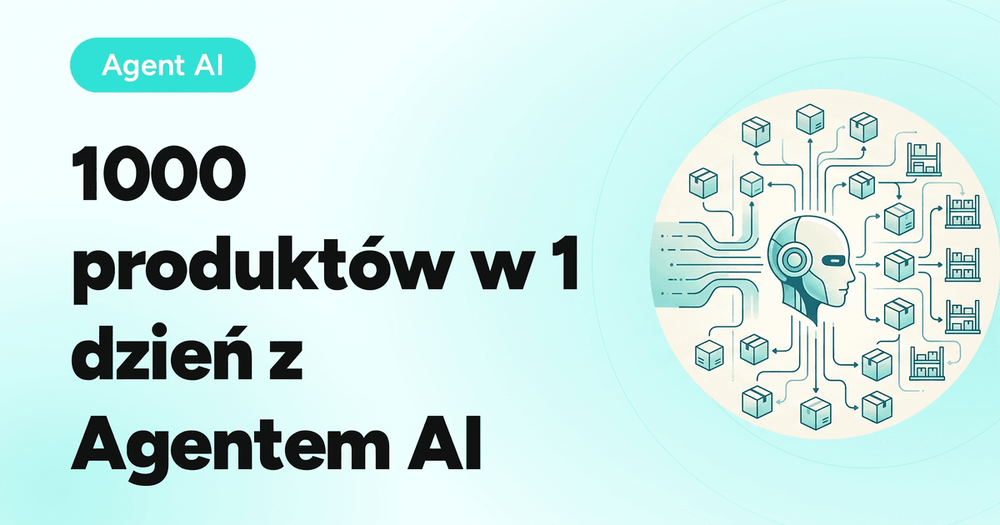
source: own elaboration
Scaling an online store within the competitive landscape of European digital commerce demands ruthless operational efficiency. Whether a company operates via dropshipping, manages a multi-brand retail storefront, or oversees a high-volume B2B wholesale distribution network, product catalog management remains the primary operational bottleneck. Launching a new seasonal inventory line, absorbing stock from a liquidated distributor, or onboarding a new vendor often paralyzes merchandising and back-office teams for weeks on end.
Manually transcribing technical parameters, downloading imagery, and reformatting spreadsheets from Excel is notoriously error-prone, draining both time and capital. Fortunately, rapid advancements in artificial intelligence have propelled the market beyond simple text generators toward autonomous back-office agents. Implementing a dedicated AI Product Onboarding Agent transforms listing thousands of new SKUs within twenty-four hours from a logistical nightmare into a scalable, repeatable business standard.
The Current State of the Market: From Experimental Chatbots to Autonomous Back-Office Agents
The European e-commerce and omnichannel retail landscape is experiencing an accelerated diffusion of practical enterprise automation tools. According to data published by Eurostat, an average of 20% of enterprises across the European Union have formally integrated artificial intelligence technologies into their workflows. Nonetheless, marked regional discrepancies persist: the DACH region (Germany, Austria, Switzerland) is recording rapid adoption growth rates of 34% year-over-year according to Echocall's market analysis, whereas Central and Eastern European markets demonstrate formal enterprise adoption rates between 8.4% and 8.7%, despite front-line employees showing some of the highest grassroots enthusiasm for AI tools anywhere in Europe.
Concurrently, enterprise architecture is shifting fundamentally from basic assisted copilots toward fully task-specific, agentic systems. Globally, the enterprise agentic AI market was valued at $5.2 billion in 2024, with projections surging to $196.6 billion by 2034 according to a Market.us report.
Key Fact: As highlighted in Gartner's report on autonomous enterprise applications, by the end of 2026, 40% of enterprise applications will feature task-specific AI agents, up from less than 5% in 2025.
However, widespread enthusiasm carries inherent operational hazards. Gartner projects that through 2027, more than 40% of enterprise agentic AI deployments could fail to achieve expected ROI. The root cause rarely stems from limitations in large language model reasoning capabilities; rather, it stems from organizational deficiencies, unstructured data silos, and the systemic failure known as "automating chaos." Deploying an autonomous AI agent over a fragmented, broken pipeline simply produces downstream errors at machine speed. Consequently, long-term commercial success does not come from installing a generic conversational chatbot, but from deploying specialized, dedicated agents engineered specifically for rigid, rule-governed catalog workflows.
Why Now Is the Defining Moment to Deploy an AI Product Agent
Market dynamics are forcing online merchants across Europe to overhaul their product data infrastructure due to three primary drivers:
- A Rapidly Closing Window of Competitive Advantage: As computing costs decrease and model efficiencies improve, the capability to instantly integrate thousands of SKUs is transitioning from a privilege reserved for retail giants into a baseline industry requirement in line with AtomStore industry insights. Merchants still relying on manual data entry will inevitably lose digital shelf visibility across search engines, shopping feeds, and price aggregators.
- Eliminating the True Cost of Stockouts and Cancellations: Every customer order placed for an out-of-stock item deals a compound blow to commercial margins. Retailers forfeit non-refundable transaction fees charged by payment gateways (such as Stripe, PayPal, or Klarna), squander customer support labor, and incur negative brand reviews that permanently depress conversion rates.
- Regulatory Mandates and EU Compliance: Enacted European regulations, such as the EU AI Act (notably Article 50, which establishes comprehensive transparency regimes taking full effect in August 2026), mandate strict accountability, data governance, and traceability for commercial algorithmic systems. Deploying structured, controlled architectures guarantees absolute compliance with both European Union consumer protections and stringent GDPR mandates.
The True Cost of Inventory Misalignment: Spreadsheets vs. Operational Reality
E-commerce managers routinely navigate a recurring operational headache: maintaining relationships with dozens of independent manufacturers and wholesalers, each transmitting data in entirely disparate formats. One supplier delivers complex, nested XML feeds; another emails inconsistent spreadsheets with arbitrary column headers; a third publishes price updates exclusively as locked PDF catalogs; while a fourth requires manual authentication through an outdated B2B wholesale portal.
A typical Monday for an e-commerce catalog specialist is spent manually copying rows, stripping out irregular whitespace, converting international currencies, and wrestling with category hierarchies. The downstream result? Product inventory levels and pricing tiers remain persistently out of sync. In high-velocity retail, a 24-hour sync delay frequently triggers overselling out-of-stock merchandise or listing goods at wholesale prices that fail to reflect unannounced manufacturer price increases.
Key Fact: Operational research into European enterprises reveals that manual administrative tasks and data entry occupy more than 65% of operational employees' time. Automating these data extraction pipelines can save dozens of labor hours per workstation each month according to Webmakers case studies.
Strategic Comparison: How E-Commerce Businesses Manage Product Catalogs
To evaluate the impact of an autonomous catalog agent, consider the three primary operating models used by modern e-commerce brands:
| Feature / Strategy | Manual Entry (Zero Automation) | Custom Integration Scripts (CRON / IT) | TrafficWatchdog AI Product Onboarding Agent |
|---|---|---|---|
| Time to Launch 1,000 SKUs | Several weeks (hundreds of manual hours) | A few minutes (after months of development) | Under 24 hours with complete descriptions and HD media |
| Resilience to Format Changes | High (humans spot shifts, but at extreme labor cost) | Zero (a single modified column name breaks the pipeline) | High (intelligent semantic mapping and anomaly detection) |
| Product Creation from EAN Codes Only | Manual Google research, copy-pasting specifications | Impossible without complex, expensive external APIs | Fully autonomous: end-to-end extraction of specs, assets, and copy |
| Internal IT Resource Drain | None (yet high operational fatigue on merchandising staff) | Very high (demands continuous patch cycles and debugging) | Zero client-side engineering (managed entirely on TrafficWatchdog infrastructure) |
| Pricing and Stock Error Risk | High (human fatigue, copy-paste and transposition errors) | Moderate to High (parsing errors occur without automated validation) | Minimal (integrated margin-variance guardrails, backups, and anomaly logs) |
How the AI Product Onboarding Agent Operates in Practice
The AI Product Onboarding Agent is an enterprise-grade agentic configuration developed by TrafficWatchdog. Engineered to sit seamlessly between raw supplier data feeds and the merchant's underlying e-commerce platform, the agent operates across two primary use cases:
Scenario 1: Continuous Stock and Price Synchronization
Consider an omnichannel retailer sourcing thousands of products from twenty independent suppliers. Each distributor provides catalog updates through different channels and refresh cadences (such as secure FTP drops, daily CSV/XLS email attachments, authenticated B2B distributor portals, or publicly indexed price listings).
- Data Ingestion: The agent connects to data sources on scheduled cadences, handling REST APIs, SFTP credentials, and authenticated B2B portal scraping with equal reliability.
- Normalization and Semantic Mapping: The system automatically analyzes source data schemas, normalizes international currency symbols, handles unit-of-measure conversions, and maps dynamic attributes directly to the target storefront structure.
- Inventory Reconciliations: The agent continuously cross-checks active catalog records against the distributor's latest verified inventory counts.
- Automated Availability Routing: The moment a vendor runs out of stock, the agent deactivates the listing, updates stock to zero, or hides the product page. This prevents unfillable orders while safeguarding conversion rates.
- Executive Action Reporting: Store operators receive clear, consolidated status alerts, such as: "Successfully reconciled 847 SKUs. 34 items disabled due to upstream distributor stock depletion. 12 items flagged for manual review due to an irregular margin variance exceeding 15%."
Scenario 2: Autonomous Product Page Creation from Barcodes (EAN/UPC)
A common growth challenge occurs when an e-commerce business purchases an overstock lot, secures a bulk supplier closeout, or signs a distributor that provides nothing more than a bare spreadsheet containing barcode numbers and wholesale cost prices. Manually building full product listings for a thousand such items often takes months of back-office labor.
The AI agent handles this entire onboarding cycle autonomously:
- It accepts a batch list of EAN, ISBN, or UPC barcodes.
- It queries authorized brand databases, product registries, and official manufacturer portals.
- It compiles product titles, detailed technical specifications (dimensions, gross weight, electrical parameters, material composition), and retrieves high-resolution, unwatermarked product imagery.
- It categorizes each item into the store's taxonomy tree and applies relevant search tags.
- It generates clean import files (CSV/XML) or syncs data directly into the store via REST API.
Security, Architecture, and Safe System Integration
A primary hesitation when automating core operational infrastructure is the fear of corrupting the store database or overwriting accurate product data. The TrafficWatchdog AI agent eliminates this risk through enterprise-grade architectural guardrails:
- Human-in-the-Loop Verification: During the initial onboarding period, the agent operates in an assisted audit mode. It produces difference logs and staged preview files that your merchandising team can review and approve with a single click. Full autonomy is enabled only after system accuracy is thoroughly established.
- Defensive Guardrails and Thresholds: Administrators can configure strict defensive parameters, such as forbidding price adjustments beyond a specified percentage or preventing mass deactivations exceeding 10% of the active catalog in a single run without explicit management sign-off.
- Platform-Agnostic Compatibility: The system integrates natively with major global and European e-commerce platforms, including Shopify, WooCommerce, PrestaShop, Magento, Shoper, and IdoSell, leveraging secure REST APIs and optimized bulk-import protocols.
Ecosystem Synergy: Amplifying Performance with TrafficWatchdog Tools
Clean, dependable catalog data forms the bedrock upon which the rest of a brand's digital growth engine is built. Within the TrafficWatchdog software suite, a verified product catalog unlocks immediate cross-functional performance gains:
- Ads Bot AI: When inventory levels and technical parameters are 100% accurate, Ads Bot AI optimizes Google Ads and Performance Max campaigns with precision. It automatically pauses ad spend on items that have sold out upstream, eliminating wasted advertising budget.
- eSales Assistant AI: This intelligent 24/7 conversational commerce assistant draws its real-time product knowledge directly from the verified product feed. It provides shoppers with accurate technical specifications, recommends relevant in-stock alternatives, and never misinforms customers about inventory availability.
Frequently Asked Questions (FAQ)
What technical prerequisites are required to deploy the AI Agent?
Implementation is managed entirely by the TrafficWatchdog engineering team. Your internal team does not need dedicated software engineers or IT personnel. Deployment simply requires granting API access to your e-commerce platform or providing sample import structures (such as CSV or XML templates). If your supplier distributes inventory data through an authenticated B2B portal, read-only credentials will be required so the agent can retrieve current price lists.
- Discovery: We evaluate your upstream distributor feeds and target platform architecture.
- Configuration: Our technical specialists configure semantic mapping rules, validation logic, and defensive thresholds.
- Staging Tests: The agent is deployed in test mode with automated anomaly logging before going live in production.
What happens if a supplier changes their file schema or web layout?
Traditional brittle automation scripts break when formats change, often going unnoticed for days and leading to inventory discrepancies. Under the TrafficWatchdog managed service model, agents are monitored continuously. If the system flags an unexpected structural anomaly in a supplier's feed, an alert is instantly escalated to our engineering team to resolve the mapping before any bad data touches your store's live catalog.
Are product descriptions created by the AI Agent unique and SEO-optimized?
Yes. When generating listings from EAN/UPC codes, the agent extracts verified technical specifications and uses a generative engine to craft unique, high-converting product descriptions. Content is structured according to your brand's unique tone of voice and optimized for traditional search engine rankings as well as AI search engines, eliminating duplicate content penalties.
How does the agent handle image licensing and copyright?
The agent retrieves official, high-resolution product photography released by manufacturers for wholesale distribution and commercial display. We recommend verifying that your vendor contracts include standard resale and marketing display permissions for these assets. Alternatively, the agent can import all technical attributes and descriptions while leaving image ingestion to your internal photography team.
Key Performance Indicators (KPIs)
| Performance Metric | Before Deployment | After Deployment | Source |
|---|---|---|---|
| Product Onboarding Time (from EAN code) | 10–15 minutes per SKU (manual search for copy, specs, and photos) | Under 30 seconds per SKU (fully automated data enrichment and formatting) | TrafficWatchdog Documentation (Scenario B) |
| Supplier Inventory and Price Update Frequency | Manual, once daily or irregular (frequent delays with CSV/PDF/XML updates) | Continuous and automated around the clock (FTP, Email, Web, API) | TrafficWatchdog Documentation (Scenario A) |
| Risk of Overselling Out-of-Stock Items | High (delayed stock syncs leave unavailable inventory purchasable) | Minimized (automatic deactivation of exhausted SKUs and critical stock alerts) | TrafficWatchdog Documentation (Scenario A) |
| Manual Back-Office Staff Allocation | 100% of available hours consumed by manual copying and column mapping | Limited to batch reviews (human-in-the-loop) or 0% (fully autonomous mode) | TrafficWatchdog Documentation (Agent Modes) |
Summary
Transitioning from manual data entry to automated agentic workflows does more than save hundreds of labor hours—it protects the fundamental profitability and agility of your digital commerce operations. Key takeaways for e-commerce leaders include:
- Scale Without Expanding Headcount: Onboarding 1,000 new products or integrating 10 new suppliers no longer requires hiring additional back-office staff; the workload is managed entirely by scalable AI infrastructure.
- Eliminate Order Cancellations: Continuous, real-time inventory synchronization prevents overselling, protecting profit margins from payment gateway refund fees and preserving customer loyalty.
- Accelerated Time-to-Market: New product lines generated directly from raw EAN lists can be launched to digital storefronts in hours rather than months.
- Enterprise-Grade Data Governance: Multi-layered safety thresholds, detailed anomaly logging, and dedicated engineering oversight remove the risk of catalog corruption or accidental pricing mistakes.