Manual Mailing vs AI Email Generator: How to Cut Quote Creation Time by 90%
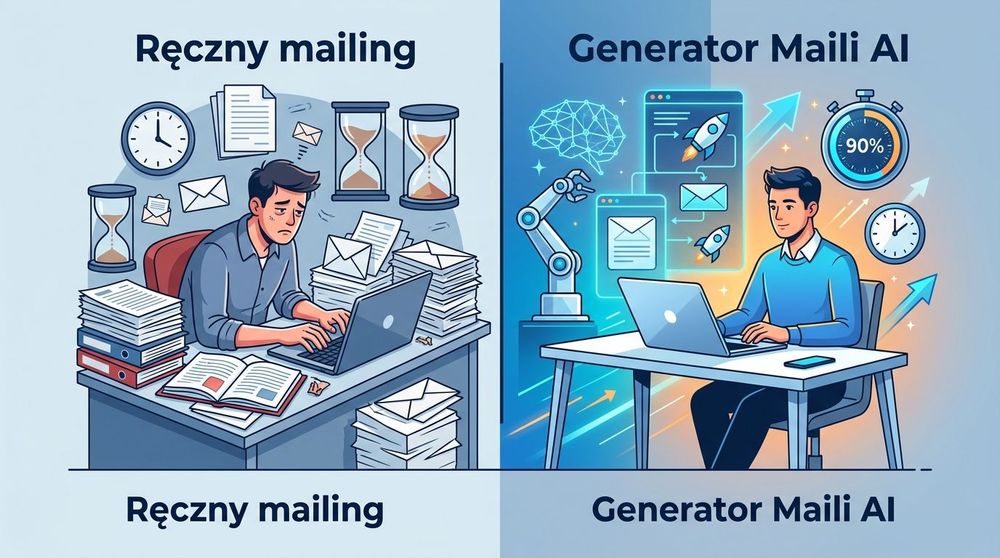
source: own elaboration
Why Modern B2B Businesses Calculate ROI Before Implementing AI
The modern e-commerce and B2B sales market is undergoing a clear transformation. The first wave of uncritical enthusiasm for artificial intelligence is giving way to cold economic calculation. As noted by Krzysztof Zelazowski, analyst at PMR Market Experts, Polish and European enterprises are taking a more rigorous approach to verifying technology projects at the pilot stage. Business decision-makers are no longer just asking what a given language model can do, but are demanding hard proof of how it will translate into time savings, operational cost reduction, and increased conversion rates.
This strategic maturity is particularly visible in Europe, where the level of artificial intelligence adoption remains highly diversified regionally. While Nordic countries lead the statistics (Denmark reaches 42% adoption, Finland 37%), Central and Eastern Europe, including Poland with an adoption rate of 8-9%, is intensively catching up, as confirmed by data from Ipsos and Eurostat. Regardless of geography, the key to AI budget approval is a precise calculation of the return on investment (ROI).
Key fact: According to an extensive study of AI implementations in the B2B sector included in the AI ROI Dataset by Denis Atlan, the median ROI for off-the-shelf AI solutions in the business channel is as high as +159.8% over a 24-month period, and the average time to reach the breakeven point is just 8 months.
To understand where such high profitability ratios come from, one must compare the costs of traditional, manual quote emailing with the effects of AI-assisted automation.
| Benefit category | Observed market impact (research data) | Main data source |
|---|---|---|
| Salespeople time savings | Freeing up 12 to 15 hours of work per week per employee thanks to content preparation automation. | [Optifai Analysis](https://vertexaisearch.cloud.google.com/grounding-api-redirect/AUZIYQEK_KJPaZriiNQsOfF-7VdsAIkua4FwwCRsBxcE3geAqWdHLJ3Dge3smcbs_v4MVG1avakk4_SwiWph8HwmiyO0why_5UnTekLgoWakWQ6gl6RQxUBaGK-Dy_qQ8a34WgZtz5P8K3xy) |
| Manual work reduction | Reducing the time needed to create technical descriptions and product offers by approx. 75%. | [Hexaware Technologies Case Study](https://vertexaisearch.cloud.google.com/grounding-api-redirect/AUZIYGyuHQvwI-4i7jLpWF1U0BgBCsYvVP3g4PLmJV89FispG9Jzh7TsPfY_xcLfWRYMQJsyVX7Jwc3LnYb8lIlSDcRcZE566k0HGB24Yn4p-Dv1OSaX0LSPags4hNmNfUv3HQ4KRJxHkB8Vnldrb3Rv3HECwk868avgYTSHw==) |
| Increase in conversion and engagement | A 3.2-fold increase in reply rates to personalized emails. | [Optifai Analysis](https://vertexaisearch.cloud.google.com/grounding-api-redirect/AUZIYQEK_KJPaZriiNQsOfF-7VdsAIkua4FwwCRsBxcE3geAqWdHLJ3Dge3smcbs_v4MVG1avakk4_SwiWph8HwmiyO0why_5UnTekLgoWakWQ6gl6RQxUBaGK-Dy_qQ8a34WgZtz5P8K3xy) |
| Revenue growth | A 10% to 15% increase in revenue thanks to precise matching of the offer to the customer's buying intent. | [McKinsey "Next in Personalization" Report](https://vertexaisearch.cloud.google.com/grounding-api-redirect/AUZIYQEXsyU-kKrkig59P5GiolVO6dOas3-mglIpWM9rk3-zOif5Yv49gL1pkGkvN7edjNIW1j5P9VlGJtbwoqL07_XcnJvpBtFaA7BfGsYw1dNzXFb9pIMhZfneyXIrNRR28B-e69I64qyNc5TqjRQtxYWyYA==) |
Manual Mailing vs AI Email Generator: Where Is Your Budget Leaking?
The traditional process of handling sales inquiries in B2B e-commerce relies on repetitive, manual tasks. When a customer sends an inquiry via email, a customer service representative or salesperson must:
- Read and interpret the message.
- Log in to the e-commerce system or ERP to check product availability, technical specifications, and current prices.
- Manually draft a grammatically and stylistically correct response.
- Manually copy product links and attachments.
This process takes an average of 15 to 20 minutes per message. With dozens of inquiries a day, this time adds up to a full-time position for one or more employees. What is more, a long Time-to-Response lowers the chance of conversion – today's business buyer expects immediate feedback.
The AI Email Generator from TrafficWatchdog drastically shortens this path. As an optional add-on to the AI e-Seller virtual assistant, this tool uses the same advanced language models and integrated store knowledge sources to prepare a ready-made response draft in seconds.
How Does the AI Email Generator Work?
The operating mechanism is based on full integration with the store's product database. The tool draws up-to-date information directly from:
- Google Merchant Center account (preferred, fully automated solution).
- XML product feeds (generated by platforms such as Shoper, IdoSell, PrestaShop, or WooCommerce).
- Dedicated store platform API.
- Direct product page scraping.
Additionally, the bot has access to the store's knowledge base (terms and conditions, delivery terms, FAQ, return policy), which it automatically updates. As a result, the prepared response is always precise, factual, and tailored to the product range.
Key fact: The AI Email Generator implements a Human-in-the-Loop approach. The tool does NOT reply to messages automatically without staff knowledge. Instead, it creates a ready, fully personalized response draft that an employee can verify, correct with a single click, and send. This eliminates the risk of so-called AI hallucinations, which Denis Atlan from the European Commission points to as the main risk factor in fully autonomous conversational systems.
Integration with Gmail via Google Apps Script
An extremely strong advantage of the AI Email Generator is the ability to connect it directly to a Gmail inbox using Google Apps Script. In practice, this means that the customer service employee does not even have to leave their inbox. By assigning appropriate labels to incoming messages, they trigger the bot, which automatically generates response drafts in the drafts folder. Each email processed this way is billed as one conversation within the monthly limit of the chosen AI e-Seller package.
Impact of the AI Email Generator on Individual ROI Categories
1. Reducing Quote Creation Time by 90%
Instead of writing messages manually for 15 minutes, an employee spends about 1.5 minutes reading the AI-generated draft and clicking the "Send" button. The time savings are exactly 90%. This allows for a drastic increase in sales department capacity without having to recruit more staff.
2. Operational Cost Optimization and Low Entry Barrier
The AI Email Generator is an extremely cost-effective solution. As an add-on, it costs only PLN 150 per month added to the basic AI e-Seller package. The basic AI e-Seller Starter package starts at PLN 300 per month (includes a limit of 250 conversations/emails, scanning of 15 content pages, and up to 10,000 products). The total cost of entering advanced email automation is therefore just PLN 450 per month – a fraction of the cost of hiring an employee, and the return on investment is immediate.
3. Reduced Response Time and Increased Conversion Rates
Response speed in B2B e-commerce directly correlates with the chance of closing a deal. A customer who receives a comprehensive offer with product links 5 minutes after sending an inquiry is less likely to look for alternatives from competitors. A consistent knowledge base ensures that the bot recommends exactly those products that match the customer's needs, increasing the average order value.
Compliance with the AI Act and GDPR in Europe
Implementing AI-based systems in the European market involves complying with strict legal standards. Generative tools, such as the AI Email Generator, fall under the EU's AI Act. It classifies such solutions as Limited Risk systems. They require compliance with transparency obligations, meaning that the recipient should be aware of interacting with a system that generates content by machine.
Crucially in the context of GDPR, maintaining human control over the final form of the message (Human-in-the-Loop) ensures that this process does not fall under the restrictive Article 22 of the GDPR regarding fully automated decision-making and profiling without human intervention. This protects the enterprise from potential administrative fines and legal disputes.
How to calculate ROI for your company?
To estimate the profitability of implementing the AI Email Generator in your online store or B2B company yourself, carry out a simple calculation according to the scheme below:
- Step 1: Determine volume and time. Count the average number of email inquiries handled by your team per month (e.g., 400 emails). Assume that the average time to manually prepare an offer is 15 minutes (0.25 hours) per message.
- Step 2: Calculate current labor costs. Multiply the number of emails by the time and the average hourly labor cost of an employee (e.g., PLN 40 gross including employer costs).
Example:
400 emails * 0.25 h * PLN 40 = PLN 4,000of monthly operational costs. - Step 3: Calculate the cost after AI implementation. The AI Email Generator reduces working time by 90% (to 1.5 minutes, i.e., 0.025 hours per email). Add the TrafficWatchdog subscription cost (AI e-Seller Growth package PLN 500 + AI Email Generator add-on PLN 150 = PLN 650).
Example:
(400 emails * 0.025 h * PLN 40) + PLN 650 = PLN 400 + PLN 650 = PLN 1,050. - Step 4: Calculate net profit and ROI. Subtract the new cost from the old one.
Monthly profit:
PLN 4,000 - PLN 1,050 = PLN 2,950in savings. Monthly ROI:(PLN 2,950 / PLN 650) * 100% = 453%.
This calculation shows that even with a moderate volume of correspondence, the investment in the AI Email Generator pays off many times over in the very first month after launch.
Frequently Asked Questions
How does AI e-Seller differ from traditional chatbots?
Unlike traditional scripted chatbots (which require clicking predefined buttons) or bots based on simple keywords, AI e-Seller uses the latest language models. It understands the customer's intent and context regardless of how the question is phrased and conducts a natural, fluid conversation.
Does AI e-Seller have access to the store's current product database?
Yes. AI e-Seller has full access to the product catalog. It uses smart search to suggest the best-matching products to customers based on context and parameters, presenting them along with photos, prices, and names.
What does the bot's integration with external systems and CRM look like?
AI e-Seller offers the possibility of full integration with external store systems. This allows the chatbot to automatically check the customer's order status, retrieve data from CRM systems, and support complaint handling.
How does the chatbot support direct sales closing?
In addition to recommending products, AI e-Seller conducts an active sales dialogue, asks about preferences, and helps make a purchasing decision. Additionally, it can grant individual discount codes, which is extremely effective for returning users.
Does the system operate continuously and how does it handle peak hours?
Yes, AI e-Seller operates as a virtual assistant available 24/7. It handles customer inquiries immediately, without breaks, delays, or queuing, regardless of the time of day or night.
Are there additional tools available to support email communication?
Yes, an optional extension of the AI e-Seller bot is the AI Email Generator. This is a dedicated tool that supports Customer Care employees in efficiently and professionally generating responses to emails.
Summary
Transitioning from traditional, fully manual mailing to the AI-assisted AI Email Generator is a step that brings immediate and measurable business benefits:
- 90% reduction in working time: Frees salespeople from tedious rewriting of product data, allowing them to focus on active sales and relationship building.
- Use of a consistent knowledge base: The tool operates on the same integrations (GMC, XML feed, API) as the AI e-Seller chatbot and AI Phone, eliminating the need to enter the same data multiple times.
- Ensuring legal compliance: The Human-in-the-Loop model guarantees full compliance with the EU AI Act and GDPR regulations.
- Exceptionally low entry barrier: The add-on costs just PLN 150 per month, and a free 14-day trial period allows you to test the effectiveness of the solution on your own data before making a purchase decision.