AI Fraud Detection Agent: The Autonomous Auditor for Google and Meta Ads
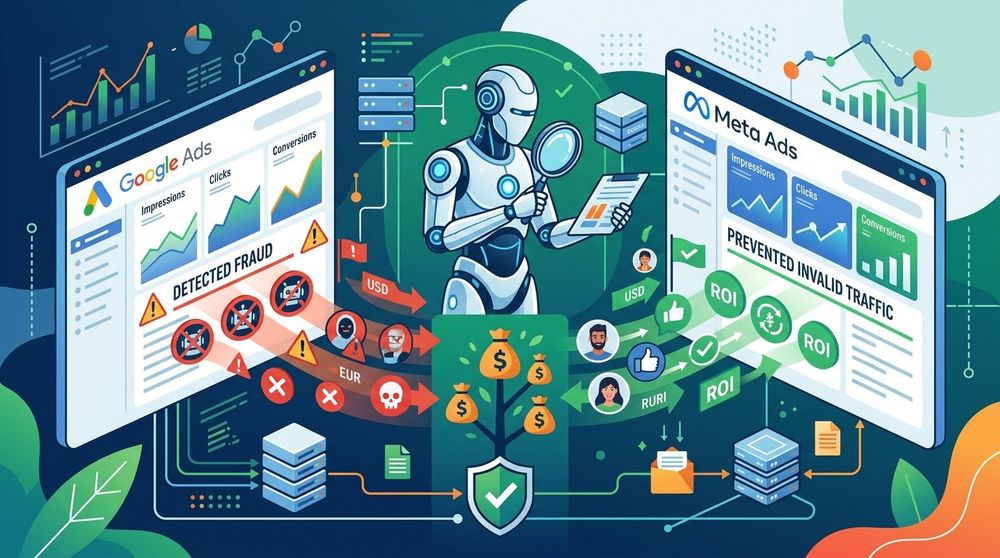
source: own elaboration
Introduction — A New Era of Ad Campaign Auditing
Artificial intelligence (AI) has advanced rapidly in recent years — moving from simple conversational models to advanced agentic artificial intelligence (Agentic AI). A dedicated AI Agent is a system that not only analyzes data but also possesses the ability to autonomously plan, use external APIs, and take specific actions in a digital environment without constant human supervision.
In digital marketing, and specifically in the area of ad budget protection, this technology is setting a new standard. Traditional anti-fraud systems relied on rigid rules that were easy for advanced bots to bypass. Modern solutions, such as the AI Fraud Detection Agent from TrafficWatchdog, act as 24/7, autonomous auditors for Google Ads and Meta Ads campaigns. They analyze millions of clicks in real time, create virtual device fingerprints, and automatically eliminate fraudulent traffic before it can deplete the advertising budget.
Why Companies Calculate ROI Before Implementing AI
Implementing innovative technologies in the B2B sector is no longer driven solely by fascination with novelty. Executives and Chief Financial Officers (CFOs) demand hard evidence that an investment will yield a tangible return. Calculating the Return on Investment (ROI) before deploying agentic solutions has become a standard operating procedure for several key reasons:
- Business justification of expenses: Enterprise-grade tools require budget allocation. Demonstrating that the cost of a license is many times lower than the losses generated by ad fraud makes it easier to obtain board approval.
- Labor cost offset: In Central and Eastern European countries, rising labor costs and demographic pressures are forcing companies to automate repetitive processes. As economic analyses indicate, higher hourly labor costs directly stimulate the adoption of automation technologies.
- Regulatory risk management: The introduction of regulations like the EU AI Act in the European Union imposes auditing obligations on companies. Businesses must calculate not only the profits from automation but also the costs of ensuring legal compliance.
Key Fact: According to a report by advisory firm Paul Okhrem, implementations of dedicated AI agents in the B2B sector deliver an average ROI of 3.5x within 12–18 months of deployment.
Savings Categories Enabled by the AI Agent
Implementing an autonomous ad campaign auditor generates benefits across several key operational and financial areas. The table below presents a detailed comparison of these savings categories:
| Savings Category | Type of Waste Without AI | AI Agent Impact (TrafficWatchdog) | Estimated Benefits (Based on Research) |
|---|---|---|---|
| Direct Media Costs | Payments for bot clicks, click farms, malicious competitor clicks | Automatic blocking of IPs and devices (virtual fingerprint) in Google and Meta Ads | Recovery of up to 21% of ad spend |
| Team Time and Labor | Manual analysis of IPs, server logs, and preparing refund claims for Google | Autonomous 24/7 monitoring, automatic generation of ready-to-submit refund reports | Over 90% reduction in analysis time |
| Conversion and ROAS | Skewed data in GA4, poor optimization decisions, artificial CTR inflation | Filtering traffic at the source, cleaning signals for Smart Bidding algorithms | Average CPC drop of 56%, CTR increase of 32% |
| Attribution Protection (Affiliate) | Cookie stuffing, commission theft via malicious browser extensions (click hijacking) | Affiliate Scanner detects hidden iframes and anomalies in the attribution path | Elimination of unjustified CPS/CPA commissions |
Key Fact: Market analyses published by Vivansh Infotech prove that implementing autonomous anti-fraud systems saves an average of up to 21% of advertising budgets by instantly filtering out non-human traffic.
How the AI Agent Impacts Each Category: An Analysis of TrafficWatchdog Technology
Real-Time Media Budget Protection
The primary task of the Click Scanner product, which is part of the TrafficWatchdog ecosystem, is to identify and block invalid traffic (ad fraud) in accordance with IAB standards. The system utilizes an advanced virtual fingerprint (device signature), collecting anonymous technical parameters (such as operating system platform, graphics card, installed fonts, or inconsistencies in the declared browser).
As a result, even if a fraudulent user or botnet dynamically rotates IP addresses, the AI Agent groups these requests by their unique device profile and blocks them. Blocking is executed in two ways:
- API Access to Google Ads (IP Blocking): By granting manager permissions to the
clickscanner@trafficwatchdog.placcount, the AI Agent automatically adds fraudulent IP addresses to exclusions in the client's campaigns. This works in real time, protecting the budget from repetitive attacks. - Remarketing Lists (Google Ads and Meta Ads): The system creates a dynamic list of users identified as fraud, which is automatically excluded from displaying ads in Meta (Facebook, Instagram) and Google ad panels. Note that these platforms require a minimum of 100 active users on the list within the last 30 days for the exclusion to take effect.
Importantly for modern marketers, the AI Agent also effectively protects Performance Max (PMax) campaigns. Due to the specific nature of PMax, exclusions must be applied at the entire ad account level, which the TrafficWatchdog system executes in a fully automated manner.
Eliminating Operational Time Waste
Analyzing server logs, comparing discrepancies between Google Analytics and advertising platforms, and manually excluding suspicious locations are extremely time-consuming tasks. The AI Agent operates 24/7, performing these activities autonomously.
Additionally, in the event of detecting so-called ghost clicks (situations where ad networks report clicks that never actually loaded the script on the landing page), the system generates ready-to-submit refund reports for Google Ads. This allows companies to apply for official refunds for invalid traffic, relying on an independent, certified measurement source.
Cleaning Analytical Data and Improving Conversions
The artificial intelligence algorithms driving modern campaigns (Smart Bidding) learn from conversion data. If a significant portion of website traffic consists of bots or accidental clicks (e.g., the so-called fat finger effect generated by deliberate ad placement on mobile portals right under navigation buttons), Google and Meta algorithms receive false signals. They then optimize campaigns for worthless users.
By filtering this traffic at the source, the AI Agent ensures that only data from real users with buying intent reaches analytical systems. This translates directly into an increased conversion rate and a lower cost per acquisition (CPA).
Affiliate Program Protection (Affiliate Scanner)
For larger e-commerce entities running affiliate programs on CPS (Cost per Sale) and CPA (Cost per Action) models, the Affiliate Scanner is a crucial module. It detects advanced attribution manipulations such as:
- Cookie stuffing (cookie dropping): Dropping cookies in hidden iframes without the user's knowledge or interaction.
- Click Hijacking: Hijacking the last click right before purchase by malicious browser extensions (such as unauthorized coupon or cashback apps).
This ensures that the advertiser does not pay commissions to entities that did not contribute to the consumer's purchasing decision.
Legal Compliance and Security (Compliance & EU AI Act)
Implementing AI-based systems in Europe must take into account strict regulatory frameworks. The upcoming European Artificial Intelligence Act (EU AI Act) categorizes AI systems by risk level. Autonomous systems making real-time decisions may, in some contexts, qualify as High-Risk solutions, which imposes transparency and human oversight obligations (Human-in-the-loop) on companies.
TrafficWatchdog ensures full compliance with legal regulations:
- GDPR Compliance: The system collects only non-personal data (technical device parameters, on-site behavior). The legal basis for processing this data is Art. 6(1)(f) GDPR, which is the legitimate interest of the controller. Recital 47 of the GDPR explicitly states that fraud prevention constitutes a legitimate interest of the business.
- Data Security: Information transmission is secured using the encrypted HTTPS protocol (SSL/TLS 1.2), and the server infrastructure complies with the strict PN-ISO/IEC 27002:2014-12 standards.
How to Calculate ROI for Your Company: A Step-by-Step Guide
To accurately estimate the return on investment from deploying an AI Agent for ad fraud detection (such as Click Scanner by TrafficWatchdog), follow these steps:
- Determine your monthly advertising budget: Add up your spend on Google Ads, Meta Ads, and other platforms billed on a CPC basis. For example: 20,000 PLN.
- Apply the average ad fraud rate: Market research indicates that without protection, an average of 10% to 21% of traffic may be non-human or malicious. Let's assume a conservative 10% (a loss of 2,000 PLN).
- Choose the appropriate TrafficWatchdog package: For a budget generating, for example, 40,000 clicks, the Growth Click Scanner package for 720 PLN/month will be ideal.
- Apply the ROI formula: $$ ext{ROI} = rac{ ext{Recovered Budget} - ext{Tool Cost}}{ ext{Tool Cost}} imes 100%$$ In this scenario: $$ ext{ROI} = rac{2000 - 720}{720} imes 100% = 177%$$
This ensures that every single zloty spent on the AI Agent returns with a surplus, while also protecting your analytical data from distortion.
Implementation Timeline
| Stage | Timeframe | What Happens | Participants |
|---|---|---|---|
| 1. Integration and Configuration | 1-3 days | Implementation of Click Scanner and Lead Scanner tracking codes on the website and integration with the Google Ads system via API to exchange data on suspicious IP addresses. | Client's IT department, TrafficWatchdog technical support |
| 2. Passive Analysis and Calibration | 4-10 days | Traffic monitoring without active blocking. Gathering device parameters (fingerprinting), behavioral analysis of traffic, and identifying bots and click farms. | TrafficWatchdog system, client's campaign analyst |
| 3. Launch of Active Protection | 11-14 days | Enabling automatic blocking of excluded IPs and devices directly in Google Ads and protecting attribution in the Affiliate Scanner. | TrafficWatchdog, client's Performance Marketing team |
| 4. Optimization and ROI Reporting | Ongoing monitoring | Regular reporting of blocked ad fraud, lead quality assessment, and calculation of recovered ad budget. | CFO, Marketing Director, dedicated TrafficWatchdog account manager |
Summary
Implementing an AI Agent for ad fraud detection is a strategic step for any business investing in online traffic acquisition. It protects marketing budgets from waste, automates repetitive auditing processes, and supports the optimization of advertising campaigns.
Key Takeaways:
- High Return on Investment: The average ROI for agentic AI systems is 3.5x within the first 12-18 months.
- Up to 21% Budget Protection: Eliminating bots, malicious competitor clicks, and ghost clicks allows you to preserve a significant portion of your advertising budget for high-value traffic.
- 24/7 Automation: Thanks to API integration with Google Ads, blocking suspicious IP addresses happens without requiring any manual effort from the marketing team.
- GDPR and AI Act Compliance: TrafficWatchdog tools collect only non-personal data, which guarantees full legal compliance in the European Union.