The Era of Autonomy in E-commerce: From Simple Chatbots to AI Agents
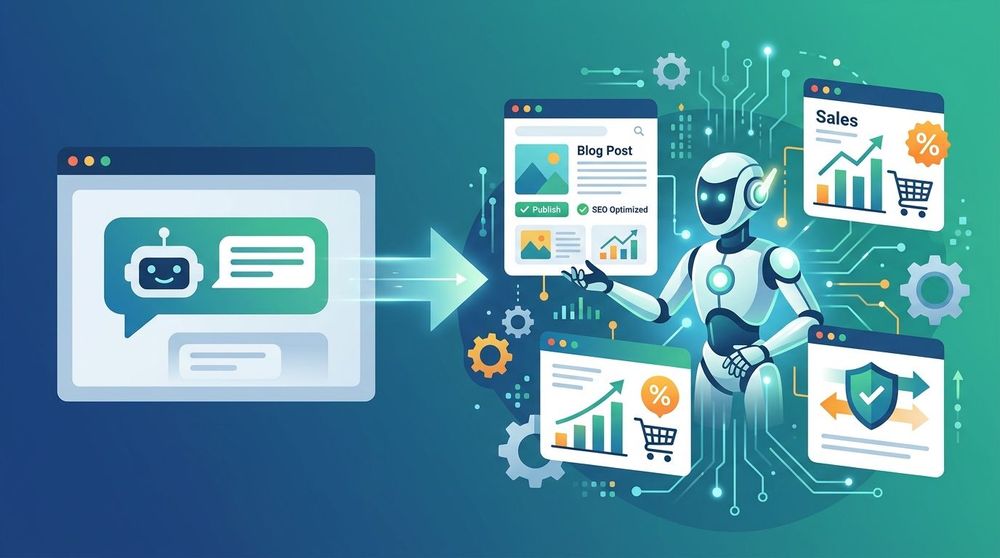
source: own elaboration
The Era of Autonomy in E-commerce: From Simple Chatbots to AI Agents
The e-commerce landscape is undergoing a fundamental shift. Traditional automation, based on rigid "if-then" rules, is no longer enough in a dynamic market. As experts point out, we are moving from the era of simple generative assistants to the era of fully autonomous systems – so-called Agentic AI. These systems can independently plan, execute, and optimize complex business processes without constant human supervision.
For a modern e-store, this means a revolution in content creation, search engine optimization (SEO), social media marketing, and video production. An AI Agent is no longer just a tool where you type in prompts. It is a virtual employee that analyzes the store's catalog, researches market trends, generates conversion-optimized blog posts, creates ad creatives, and independently publishes them across appropriate channels.
Why Now is the Best Time to Implement an AI Agent
The decision to implement autonomous content solutions in e-commerce today is backed by hard market data. Online stores face unprecedented pressure to increase the volume of published content while cutting operational budgets. An e-commerce blog is not just an optional add-on, but a key content marketing strategy that boosts visibility on Google (SEO), builds expert authority, and directly translates into sales growth. Blog posts attract high-quality traffic through advice and inspiration, allow natural internal linking to products, and build trust by educating customers before they buy.
Key fact: According to a market study by Business Wire and 10Fold as many as 91% of marketers planned to increase content production, and 46% of them intended to produce three to five times more content. At the same time, nearly 75% of teams received marginal budget increases of only 1 to 10 percent. This drastic financial gap forces automation.
An additional catalyst for change is the revolution in how consumers search for product information. Traditional SEO is giving way to new trends. An increasing number of users utilize large language models and AI-powered search engines (AI Search) to make purchasing decisions. According to market analyses, optimizing content for generative engines – known as GEO (Generative Engine Optimization) – is becoming a crucial element of e-commerce strategy. Content hidden behind login walls or written solely for traditional Google bots is losing relevance because AI recommendation algorithms cannot process it effectively. Every blog post is an extra opportunity to establish an online presence. While a store without a blog only competes for product page rankings, a store with a blog can rank for hundreds of additional informational keywords, reaching customers early in their buying journey.
| Comparison Area | No Automation (Traditional Agency / Copywriter) | In-house Solution (ChatGPT / Manual Prompting) | Dedicated AI Agent (TrafficWatchdog) |
|---|---|---|---|
| Time and commitment | Very high (briefing, revisions, emails, delays) | Medium (requires manual generation, copying, and publishing) | Minimal (full automation: planning, writing, and publishing without client involvement) |
| Integration with store catalog | Dependent on copywriter's knowledge (often superficial) | None (generic texts without direct links or product pricing) | Full (system knows the product catalog, prices, and automatically links to the store's offers) |
| Data freshness | Requires manual research by a human | Risk of AI hallucinations and outdated information from the model's knowledge base | Real-time (fetches current trends, prices, and reviews from the web in real-time) |
| Unit cost | High (80-150 PLN per single article from a freelancer) | Low (API subscription cost), but high employee time cost | Very cost-effective (e.g., package of 10 articles for 350 PLN/mo at TrafficWatchdog) |
What Sets the TrafficWatchdog AI Agent Apart?
Solutions offered by TrafficWatchdog, such as the AI Blog Agent and the AI Ad Agent, are designed to directly drive conversions, not just fill pages with empty characters. Many standard AI generators create generic text that does not translate into sales. The TrafficWatchdog AI Agent is built on three key pillars:
1. Freshness and Absence of Hallucinations
Content generated by the system does not come from closed, historical LLM knowledge bases. The Agent utilizes advanced web search capabilities, analyzing current prices, reviews, market data, and trends. As a result, articles are highly informative and trustworthy for both readers and search engine crawlers.
2. Deep Personalization and Smart Linking
This is a key advantage over generic AI tools. The system integrates with the online store's product catalog (e.g., via an XML feed or Google Merchant Center). When creating an article – like a roundup of the best Christmas gifts – the Agent does not just describe the items; it automatically embeds direct links to specific products available in the client's store, along with their current prices. The reader can make a purchase with a single click, radically shortening the conversion path.
3. Full Automation and Control
After the initial setup, the system independently schedules publishing, selects topics with high search potential, writes articles, and publishes them directly to the client's CMS platform (such as WooCommerce, Shoper, Shopify, PrestaShop, or Magento). The client does not need to perform any manual tasks and receives an automated email notification with a direct link to the new post after each publication. Your blog works 24/7 to drive your store's success.
Key fact: According to data from the Sopro State of Prospecting market report, implementing advanced marketing automation allows companies to achieve an average return of $5.44 for every $1 invested in technology, generating an average ROI of 300% due to reduced operating costs and increased conversions.
Content Formats That Actually Sell
The TrafficWatchdog AI Agent is not limited to a single type of publication. The system flexibly adapts formats to match user purchase intent, creating types of content such as:
- "Top N" Rankings and Lists: Generate very high click-through rates in search results, meeting the natural need of consumers looking for ready-made recommendations (e.g., "Top 5 Office Coffee Machines for 2025").
- Product Comparisons: Reach customers at the final stage of the buying journey when they are hesitating between specific models (e.g., "Dyson vs Miele – Vacuum Cleaner Comparison").
- Buying Guides: Build expert authority and educate the customer before purchase (e.g., "How to Choose a Bedroom Mattress – A Guide").
- Seasonal Articles: Automatically aligned with the retail calendar (e.g., Black Friday, Valentine's Day, Back to School).
Presenting a product in a natural context (such as curated outfit styles or interior designs) instead of a dry technical description has a much stronger impact on the customer's imagination and makes the final purchase decision easier.
What if Your Store Doesn't Have a Built-in Blog?
For companies whose e-commerce platforms lack a blogging module or face technical barriers, TrafficWatchdog has prepared two alternative solutions:
- Option A (Subdomain with DNS Redirection): The client creates a subdomain (e.g., blog.store.com), and TrafficWatchdog takes over its technical management, hosting a fully optimized blog on its own servers. All SEO power supports the client's main domain.
- Option B (Publishing on trafishop.pl): The client's products are promoted through informative articles on the external shopping portal trafishop.pl, allowing for quick acquisition of valuable traffic and external links.
Legal Aspects and Compliance with EU Regulations (AI Act and GDPR)
When deploying autonomous content generation systems in the European market, special attention must be paid to the legal environment. Upcoming European Union regulations, including the EU AI Act, impose transparency obligations on businesses. Starting in August 2026, all machine-generated content must be clearly labeled, aiming to protect consumers from misinformation.
Furthermore, systems processing user data to personalize offers (such as automated newsletters or ad targeting) must be fully compliant with GDPR requirements. Implementing Privacy by Design standards and ensuring the explainability of algorithmic decisions (Explainable AI) are key elements that distinguish professional platforms from simple, unverified scripts.
Frequently Asked Questions (FAQ) – AI Agent in an E-store
1. What does the AI Blog Agent implementation process look like and how long does it take?
The implementation process is extremely simple and fully automated. After registering with TrafficWatchdog and choosing the right package, our team configures the integration with your store using a secure API or an XML product feed (e.g., Google Merchant Center). The initial setup, which includes defining the brand's Tone of Voice, exclusions, and publishing schedule, usually takes up to 48 business hours. After that, the AI Agent begins working fully independently, taking the load off your team.
2. Are there any hidden costs, such as additional fees for language model API usage?
No, at TrafficWatchdog we ensure complete financial transparency. The flat monthly subscription fee (e.g., 350 PLN net for the Starter package) covers all operational costs. This includes access to advanced language models (LLMs), real-time web search, and data transfer. You pay exactly the amount of your chosen subscription, with no worries about extra bills for APIs or server infrastructure.
3. Which e-commerce platforms does the TrafficWatchdog AI Agent integrate with?
Our system has ready-made and proven integrations with the most popular e-commerce platforms on the market. These include WooCommerce, Shopify, Shoper, PrestaShop, IdoSell, and Magento. For custom or less common store engines, we offer flexible integration via a universal API or build a dedicated data exchange channel tailored to the client's infrastructure.
4. How does the system ensure my store's data security and GDPR compliance?
Data security is our top priority. All connections to your store are encrypted using SSL protocol. The AI Agent only processes publicly available product data (such as prices, descriptions, images) and has no access to your customers' sensitive personal data or transaction databases. Our procedures are fully compliant with GDPR, and all server infrastructure is located within the European Union.
5. Do I have full control over the published content, or does the system operate without my knowledge?
You have full control over every aspect of the system's operation. We offer two operating modes: fully autonomous (where articles are published automatically and you receive an email notification after publication) and moderation mode (drafts). In moderation mode, every generated article goes to your client panel, where you can read, edit, and approve it with a single click before it goes live on the blog.
6. How long after implementing the AI Blog Agent will I see the first SEO results?
The first effects in the form of Google bots indexing new pages are usually visible within a few days of publishing the first articles. A noticeable increase in organic traffic from long-tail keywords and improved search engine rankings typically occurs after 4-8 weeks of regular publishing. Systematically delivering fresh, SEO-optimized content builds domain authority, leading to long-term, stable conversion growth.
Summary
- The End of Generic Content: Modern e-stores need automation that actually sells. The TrafficWatchdog AI Agent creates content directly linked to the store's catalog and automatically links to products.
- An Edge with Real-Time Freshness: Thanks to real-time information verification, generated articles are free from AI hallucinations and provide readers with reliable data.
- Ready for AI Search: Optimizing for new generative search engines (GEO) is becoming a crucial element of building brand visibility online.
- Compliance and Security: Automation compliant with GDPR standards and the upcoming AI Act ensures full legal safety for your business in Europe.
- Implementation Flexibility: The lack of a blogging module on your store's platform is not an obstacle – thanks to the subdomain option or promotion on the Trafishop portal, any e-store can reap the benefits of SEO.