Error-Free Multichannel: How an AI Agent Synchronizes ERP and Marketplaces
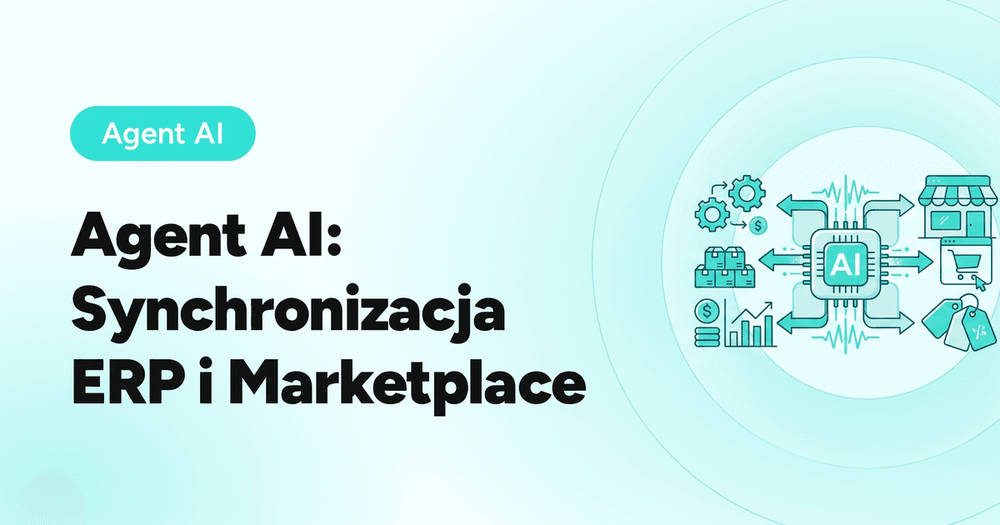
source: own elaboration
Modern e-commerce does not tolerate delays. Multichannel sales – encompassing your own online store, Allegro, Amazon, Mirakl marketplaces, or foreign platforms – have become the standard for companies aiming to scale their business. However, managing inventory from multiple suppliers, manufacturers, and wholesalers poses a massive operational challenge: how to maintain perfect, real-time synchronization of inventory levels and prices?
Traditional integration methods based on rigid scripts often fail when a supplier changes their XML file structure or when data is only available on a B2B portal requiring login. The solution to this problem is a new generation of autonomous systems – Agentic AI. The transition from simple generative models to systems based on autonomous agents represents the most important turning point in corporate digitization at the turn of 2025 and 2026. As recent research indicates, we are witnessing an evolution of software toward agents that can independently perceive the digital environment, reason, and take multi-step actions within a PRA (Perceive-Reason-Act) loop aalto.fi.
In this article, we explain how a dedicated AI Agent for product onboarding and inventory management (a specialized variant of the Business AI Agent from TrafficWatchdog) eliminates errors in multichannel sales, protects margins, and automates the e-store back-office.
The AI Adoption Landscape in Europe: Why the Time for Automation is Now
Although AI agent technology is growing at an exponential rate, its adoption level varies by geographical region. According to data published by Eurostat in 2026, the average adoption of artificial intelligence in European enterprises stands at 19.95%. Scandinavian countries (such as Denmark, Finland, and Sweden) are the leaders, with adoption rates hovering around 40%. At the same time, in Poland, only about 8.4% of companies declare AI implementation brandsit.pl.
This disparity creates an unprecedented opportunity for enterprises in Central and Eastern Europe. Companies that are among the first to implement autonomous agents to handle warehouse and catalog processes gain a massive competitive advantage. Analysis shows that implementations in process optimization and data structuring for agents can generate dramatic increases in operational efficiency, reducing the costs of individual back-office tasks by an average of 67% negreflorian.com.
What is the AI Catalog Agent from TrafficWatchdog?
The AI Agent for product onboarding is an intelligent system based on artificial intelligence that automates two of the most tedious processes in e-commerce: ongoing inventory synchronization and bulk creation of rich product pages. It acts as an intelligent bridge between supplier systems (manufacturers, wholesalers) and the client's e-commerce platform and ERP system.
The system offers two main implementation scenarios:
Scenario A: Automatic inventory and price synchronization
Traditional integrators require perfectly structured files (e.g., CSV with a fixed column layout). If a supplier changes the Excel layout, the synchronization breaks. TrafficWatchdog's AI Agent works differently – it can "understand" the data context regardless of its format. It retrieves price lists and stock levels from FTP servers, emails, PDF files, and even directly from suppliers' websites and B2B portals (logging in just like a human). It then normalizes the data, maps the columns, and updates stock levels and prices directly in the store or ERP system.
Scenario B: Creating rich product pages from barcodes (EAN/UPC)
If you only have a list of EAN codes for new products, manually filling in their names, descriptions, parameters, and photos would take hundreds of hours. The AI Agent retrieves the list of barcodes, queries external databases (such as Open Food Facts, Google Shopping, manufacturer websites), aggregates unique descriptions, high-resolution photos, and technical specifications, and then generates complete, import-ready product pages.
How does the AI Agent solve real e-commerce problems? Comparison
To understand the scale of savings and error elimination, it is worth comparing the traditional multichannel management model with a model based on an autonomous AI Agent:
| Process area | Traditional approach (Without AI Agent) | With TrafficWatchdog AI Agent |
|---|---|---|
| Supplier data format | Requires a fixed, rigid CSV/XML format. Any change on the supplier's side blocks imports. | Flexible reading of any structures (Excel, PDF, websites, APIs) thanks to semantic understanding. |
| Out-of-stock management | Delays in updates lead to selling items that are no longer in the wholesaler's warehouse. | Immediate hiding or deactivation of sold-out products on the supplier's side in real time. |
| Onboarding new products | Manual copying of descriptions, downloading photos, and filling in attributes by employees (time-consuming). | Automatic generation of full product pages based solely on EAN codes in just a few minutes. |
| Operational costs and errors | High risk of human error, costs of cancelled orders, and payment gateway fees. | Error-free 24/7 operation. Reduced back-office working hours and elimination of incorrect order costs. |
Key Benefits for Different Business Models
Whether you run a dynamic dropshipping store or manage a large B2B wholesale business, the AI Agent adapts to your needs.
- Dropshipping Stores: The key to success in dropshipping is selling only what is physically in stock at the supplier's warehouse. The AI Agent eliminates the risk of selling unavailable items by automatically deactivating products in your store when their stock at the supplier drops to zero.
- Multibrand Stores (wide catalog): Managing thousands of unique products (SKUs) from dozens of manufacturers manually is impossible. The Agent brings data from various sources into a single, consistent standard, saving human resources that can be redirected to strategic tasks.
- B2B Wholesalers: Automatic price and availability updates help maintain the trust of business partners, who instantly see current stock levels on the ordering platform.
Key fact: Selling an item that is not physically in the supplier's warehouse generates double losses. Even if the store cancels the order and refunds the customer, it incurs a non-refundable loss in the form of payment processor fees (such as Stripe, PayPal, or Przelewy24), while also losing customer trust and risking negative online reviews.
Key fact: According to forecasts in Gartner's analysis, by 2028, up to 90% of B2B transactions may be mediated or executed directly by autonomous software entities (so-called Machine Customers). Transforming your product catalog into a machine-readable structure is becoming a market necessity.
Supported Platforms and ERP Systems
TrafficWatchdog's AI Agent is designed for maximum integration flexibility. It can work with any e-commerce platform that provides an API or supports imports using structured files (CSV, XML). The system integrates seamlessly with the most popular solutions on the European market:
- Shopify: Full two-way integration via Shopify Admin API.
- WooCommerce: Automatic synchronization via WooCommerce REST API.
- Shoper & PrestaShop: Quick data import via API and dedicated exchange files.
- ERP Systems (e.g., MS Dynamics, SAP, Comarch ERP): Similar to the European case study of a B2B bakery supplier that automated order and inventory management using an agent integrated with Microsoft Dynamics NAV beam.ai, TrafficWatchdog's AI Agent can communicate directly with ERP databases to maintain information consistency.
Compliance, GDPR, and the EU AI Act
Implementing advanced artificial intelligence systems in Europe requires compliance with strict legal standards. TrafficWatchdog's AI Agent is designed in accordance with the Compliance-by-Design approach:
- EU AI Act Compliance: Entering into force in August 2026, the provisions of the EU AI Act impose strict transparency requirements on AI-based systems europa.eu. Our agents operate in a "Glass Box" model – every decision to update a price or deactivate a product is fully logged, and a human operator has constant oversight (Human-in-the-Loop) and the ability to immediately halt the agent's actions (the so-called Kill Switch).
- Personal Data Protection (GDPR): The catalog agent only processes product and inventory data (it does not process end-customer personal data), completely eliminating the risk of leaking sensitive data (PII) to external large language models.
- Elimination of Shadow AI Risk: Introducing an official, secure company solution prevents the dangerous BYOAI (Bring Your Own AI) phenomenon, where employees independently use unsecured, public LLM tools to process company data brandsit.pl.
Frequently Asked Questions (FAQ) – AI Agent Deployment and Operation
How long does system implementation take?
The implementation time depends on the complexity of the infrastructure. A simple case – one supplier providing a stable file and a store platform with an open API (such as Shopify) – can be ready within a few business days. More advanced projects (multiple suppliers, scraping websites protected against bots, custom ERPs) typically require 1 to 3 weeks.
What if the supplier does not provide any file (only a website)?
The AI Agent can "read" websites like a human and extract data from them (so-called scraping). However, it is worth noting that some websites use anti-scraping measures (e.g., CAPTCHA). In such situations, the optimal solution is for the supplier to whitelist our bot's IP address or ask them to generate a simple exchange file.
Can the agent operate in a semi-automatic mode?
Yes. We understand that full automation requires trust. The agent can operate in an assisted mode – it generates a ready-made change report (e.g., proposed price adjustments or new product pages) and waits for approval from the e-commerce manager before pushing them to production.
How does the billing model look like?
The AI Agent for product onboarding is a flexible variant of the Business AI Agent. The cost of implementation is priced individually after a free needs assessment. The standard model includes a one-time setup fee and a monthly subscription for maintenance, monitoring, and adapting the agent to changes in supplier file structures (framework packages for the Business AI Agent start at 2,500 PLN/month).
Solution Comparison
| Criterion | No automation | In-house IT solution | This AI product |
|---|---|---|---|
| implementation cost | No upfront costs, but very high, fixed operational costs of manual labor. | Very high (requires paying a development team and building infrastructure from scratch). | Low and optimized (deployment of a ready-to-use, dedicated variant of the Business AI Agent). |
| time to launch | Immediate (manual work starts right away), but extremely inefficient for large catalogs. | From several weeks to many months of design and development work. | Very short (quick configuration of a ready-to-use agent handling e-commerce). |
| technical requirements | No system requirements (entirely relies on human resources). | Very high (maintaining own servers, databases, and writing custom API integrations). | Minimal (Agent independently retrieves data from Excel, CSV, PDF, XML files, websites, FTP, email, or APIs). |
| scalability | No scalability (increasing the number of products requires hiring new employees). | Low and costly (any change in file structure on the supplier's side requires developer work again). | Very high (Agent automatically normalizes data and can independently create product pages from EAN/UPC/ISBN codes). |
| support | None (full responsibility for errors and delays lies with employees). | Requires maintaining an internal IT department for constant monitoring and fixing sync errors. | Full and hands-free (intelligent system automatically handles incompatible formats and changes on the supplier's side). |
Podsumowanie
Autonomous multichannel synchronization is not a thing of the future, but a necessity to maintain a competitive advantage in the demanding European market. Implementing the AI Agent for product onboarding and inventory management from TrafficWatchdog brings immediate business benefits:
- Operational accuracy: Eliminating the risk of selling out-of-stock items and costly returns.
- Time savings: Automatically creating rich product pages from EAN in moments instead of hours of manual work.
- Compliance and security: A solution fully aligned with the requirements of the EU AI Act and GDPR.
- Scalability: Ability to easily add more suppliers and expand your catalog without increasing back-office headcount.
Want to see how an AI Agent can optimize processes in your online store? Contact the TrafficWatchdog team and order a free needs assessment and custom quote tailored to your infrastructure.