How to Implement AI Agents Without an IT Department: An E-commerce Automation Guide
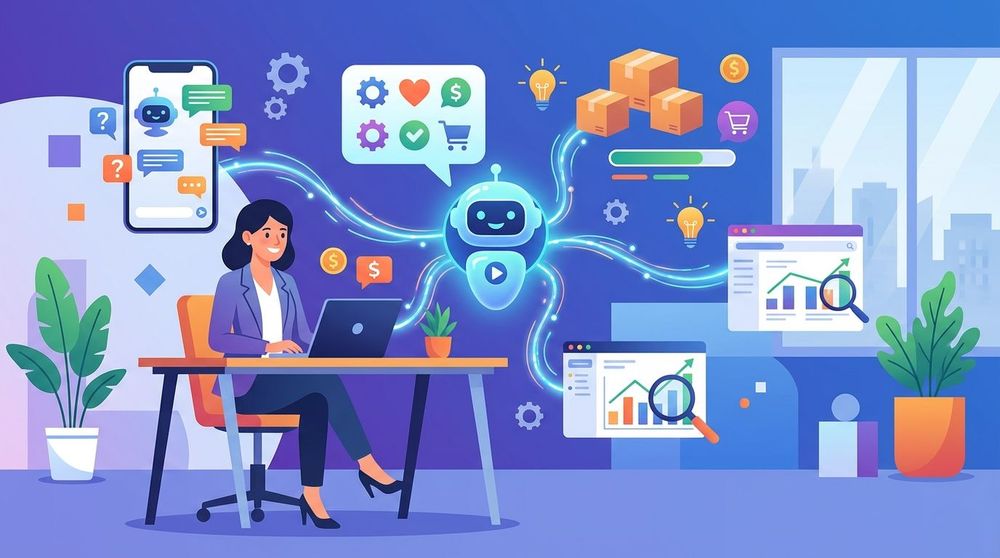
source: own elaboration
AI Revolution Accessible to Every Entrepreneur
Many e-commerce business owners still believe that implementing artificial intelligence requires an army of programmers, huge budgets, and months of development work. Nothing could be further from the truth. Today, AI technology has become democratized, and ready-to-use no-code solutions allow for the automation of key business processes in just a few days, without the need for an in-house IT department.
In an era of growing competition and increasing customer acquisition costs, AI agents are becoming an essential element of a growth strategy. They allow human teams to be relieved of repetitive tasks while offering a standard of service and optimization that, until recently, was unattainable for small and medium-sized enterprises.
Step 1: Identifying Processes for Automation
It is worth starting AI implementation by analyzing "bottlenecks" in the company. These are most often areas where a human must perform repetitive tasks or where response speed determines whether a sale is closed. In e-commerce, these are usually:
- Handling questions about product availability and technical parameters.
- Responding to customer calls outside of office hours.
- Ongoing optimization of advertising campaigns and improving descriptions in the product feed.
Step 2: Choosing AI Agents for Customer Service
If your problem is low conversion from inquiries or abandoned carts, conversational agents are the ideal solution. Tools like eSeller act as a virtual assistant that not only answers questions but actively recommends products based on user preferences. Integrating such a system usually comes down to embedding a simple script on the site and connecting it to the product feed – a process that requires no programming knowledge.
For companies struggling with a high volume of phone inquiries, the solution is AI Phone. This is an automated consultant that conducts voice conversations in real-time. Thanks to it, no customer will be left without an answer, even if they call in the middle of the night or on a non-trading Sunday.
Step 3: Marketing and Product Feed Automation
Another area that can be automated without IT support is search engine and social media advertising. Ads Bot AI takes over the tedious work of optimizing Performance Max campaigns. Algorithms automatically improve product titles and attributes in your store to better match user queries. As a result, ads become more precise, directly translating into better ROAS without the need to manually edit thousands of items in the catalog.
Step 4: Monitoring and Scaling
Implementing an AI agent is not just a one-time configuration but a process of continuous improvement. Modern platforms provide intuitive administrative panels where managers can track the effectiveness of AI activities. You can observe how eSeller closes deals or how Ads Bot AI lowers CPC in your campaigns. This data allows for making better business decisions based on facts rather than intuition.
Why It Is Worth Acting Now?
Implementing AI agents without an IT department is possible thanks to the SaaS (Software as a Service) model. By choosing proven tools from TrafficWatchdog, you get a ready-made infrastructure, technical support, and technology that learns on the fly. Companies that decide on such a transformation notice a significant increase in operational efficiency and improved satisfaction of customers who receive support instantly.
Remember that automation is not just about saving time; it is primarily about building a competitive advantage where every second of customer attention and every dollar spent on advertising counts.