Stop Overselling: How an AI Agent Automatically Syncs Inventory 24/7
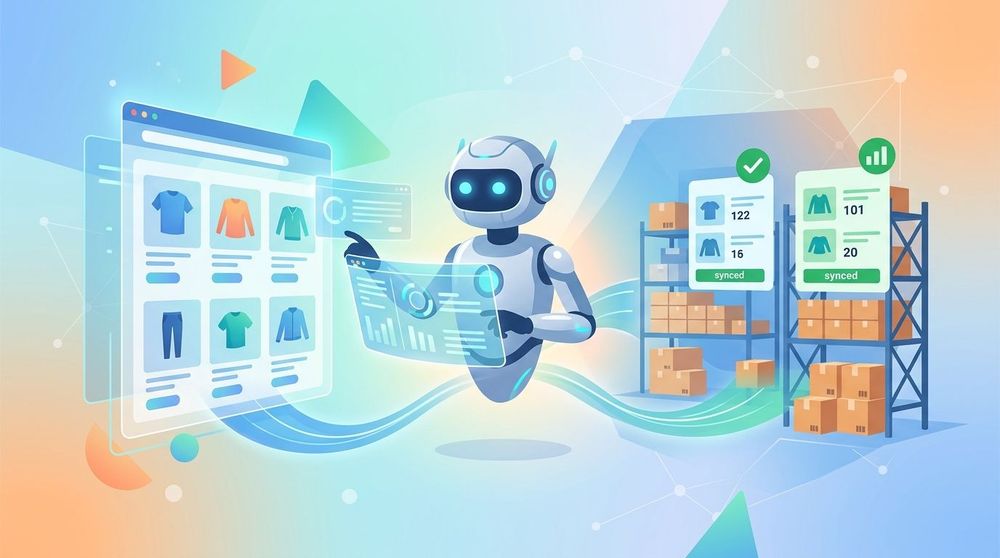
source: own elaboration
The Era of the Agentic Enterprise: Why E-commerce Is Moving Away from Traditional SaaS
The e-commerce sector in Europe is currently undergoing a fundamental transformation. For years, the market standard was classic SaaS (Software as a Service) software, which required employees to manually manage interfaces, constantly map product files, and continuously monitor inventory levels. However, according to data from research firm Fortune Business Insights, the global artificial intelligence agent (Agentic AI) market was valued at USD 8.03 billion in 2025 and is projected to reach USD 251.38 billion by 2034. This unprecedented leap marks a shift toward the so-called Agentic Enterprise or Services-as-a-Software — an era where companies stop buying just the tools for work and start purchasing ready-made, autonomously delivered business outcomes.
In the reality of e-commerce, one of the most painful and costly operational processes is maintaining inventory consistency and continuously onboarding products from multiple suppliers. When a store sells an item that is actually no longer available from the manufacturer, it leads to overselling (stockouts). This results in immediate order cancellations, lost commissions paid to payment processors, an overburdened customer service department, and an irreversible loss of buyer trust. The solution to this challenge is a dedicated AI Agent for product onboarding and inventory management — an intelligent assistant from TrafficWatchdog that automates the catalog backend of online stores and wholesalers 24/7.
Why Do Companies Calculate ROI Before Implementing AI?
In the face of macroeconomic pressure and rising customer acquisition costs, European business decision-makers cannot base their innovation deployment decisions on technological promises alone. Every investment in artificial intelligence must be preceded by a reliable return on investment (ROI) analysis. This calculation has become crucial for several reasons:
- Transition to Outcome-Based Pricing: As market analyses from Technova Partners indicate, software vendors are increasingly moving away from traditional per-user licensing toward outcome-based pricing (e.g., a fixed fee per automatically processed order or updated process). To assess the profitability of such a model, a company must precisely know its current unit cost of manual labor.
- Compliance and Legal Adaptation Costs: Implementing AI in Europe involves meeting strict regulatory requirements (GDPR, EU AI Act). Management must factor these aspects into the profit and loss balance sheet.
- Data Quality Issues at the Source: According to a study by EY Poland, only 4 out of 10 companies possess data of sufficient quality to immediately feed artificial intelligence systems. Calculating ROI helps determine whether the costs of preparing the data infrastructure will be offset by operational savings.
Key Fact: Although as many as 74% of European enterprises have launched AI-related projects, according to a report by the LLeverage platform, only 14% of them have fully operational production deployments yielding measurable business value. The main barrier remains the lack of robust ROI analysis and data integration issues.
The table below presents a comparison of traditional, manual catalog management with the autonomous operation of the TrafficWatchdog AI Agent across three key areas: time, operational costs, and conversion and revenue.
| Area of Analysis | Traditional Approach (Manual Labor / SaaS) | With TrafficWatchdog AI Agent | Measurable ROI Impact |
|---|---|---|---|
| Team Working Time | Manually downloading files (Excel, CSV, XML), mapping columns, and updating inventory takes an average of 2-3 business days per week. | Automatic data retrieval 24/7 from FTP, emails, APIs, or websites. The process takes only a few minutes and runs completely without human intervention. | Reduction of data handling time by over 90%. Reclaiming hundreds of working hours annually. |
| Operational Costs and Errors | High risk of human error during data transcription. Cost of commissions for canceled orders (Stripe, PayPal) and high payroll costs. | Automatic data validation, flawless mapping, and instant anomaly detection. Runs on secure cloud infrastructure. | Elimination of manual error costs. Significant savings on commissions and return processing. |
| Conversion and Revenue | Delays in updates cause customer loss (cancellations). Slow onboarding of new products delays the start of sales. | Instant onboarding of new collections from EAN codes. Inventory levels are always aligned with the supplier's actual stock. | Increased customer trust, no negative reviews, and faster Time-to-Market for new assortments. |
How the TrafficWatchdog AI Agent Impacts Each Category
1. Automatic Inventory Synchronization from Multiple Suppliers
Multibrand or dropshipping store owners face information chaos. Every manufacturer or wholesaler provides their catalog in a different format — from structured XML files to custom Excel sheets, PDF documents, and even data accessible only after logging into a B2B portal.
The TrafficWatchdog AI Agent acts as an invisible, flawless employee:
- Periodically retrieves data from any source specified by the client (FTP servers, email attachments, supplier APIs, or even directly from supplier websites using advanced content reading algorithms).
- Normalizes and maps data — automatically corrects formats, converts units of measurement, and matches the supplier's column structure with the requirements of the client's e-commerce platform.
- Updates stock levels and prices in real time or at a selected frequency (e.g., hourly or once a day), eliminating the risk of selling products that are physically missing from the external warehouse.
- Deactivates unavailable items — instead of displaying products as available, the agent can automatically hide them, disable them, or change their status to "awaiting delivery" according to the store owner's preferences.
2. Instant Product Page Creation from Barcodes (EAN/UPC)
Expanding the product range by hundreds or thousands of new items is a massive logistical challenge. Manually searching for descriptions, technical specifications, and images for a new list of EAN codes takes weeks. The TrafficWatchdog AI Agent drastically shortens this process:
- It retrieves a raw list of barcodes from the client.
- It independently searches global, trusted databases and official manufacturer websites.
- It aggregates complete data: trade names, descriptions, technical parameters, product photos, weight, dimensions, and automatically assigns categories and tags.
- It generates a ready-to-import file in a format compatible with the client's e-commerce system (e.g., Shopify, WooCommerce, Shoper, PrestaShop) or uploads them directly via API.
Key Fact: As shown by deployments carried out by Ignashev.ai, implementing intelligent integration with ERP systems (such as Comarch, Subiekt, or enova365) allows reducing the processing time of routine warehouse and catalog operations from 25 minutes to just 30 seconds with zero errors, generating thousands in operational savings.
European Regulatory Landscape and Legal Challenges
Deploying systems based on artificial intelligence in Europe requires a rigorous approach to legal issues and compliance. Unlike other global markets, European enterprises must operate within the boundaries set by the GDPR and the European Union's AI Act.
A key milestone for European business is August 2, 2026, when the most restrictive requirements of the AI Act regarding high-risk systems come into force. Although inventory management agents rarely qualify as high-risk systems, EU regulations place a heavy emphasis on algorithmic transparency. This means moving away from "Black Box" models toward a "Glass Box" architecture. TrafficWatchdog systems are fully auditable — they record every action taken (Audit Trail) and allow for full human control over the process (Human-in-the-Loop), guaranteeing complete legal compliance.
Additionally, in countries such as France or Germany, the implementation of labor automation systems is subject to strong social control. French jurisprudence (including court rulings in Nanterre from February 2025 and in Creteil from July 2025) clearly indicates that introducing AI tools without prior consultation with trade unions and works councils (CSE in France, Betriebsrat in Germany) can result in a court order halting the project. The TrafficWatchdog AI Agent is designed as a supporting assistant rather than a replacement for human staff, which significantly eases the consultation procedures in European enterprises.
How to Calculate ROI for Your Company? Step by Step
To reliably estimate the return on investment for deploying an AI Agent for inventory synchronization in your online store, follow these steps:
- Step 1: Calculate the direct costs of manual labor. Multiply the number of hours your team spends monthly downloading, processing, and uploading product files by the hourly rate (including tax and insurance overheads).
- Step 2: Estimate the cost of overselling. Check your store panel to see how many orders were canceled over the last 12 months due to out-of-stock items at the supplier. Sum up the lost profit (margin) from these transactions and the non-refundable commission costs from payment systems.
- Step 3: Include customer service costs. Calculate the time your support team spends resolving issues via phone and email with customers whose orders were canceled. Convert these working hours into a specific financial cost.
- Step 4: Compare with the costs of deploying the AI Agent. The service is billed in a transparent model: a one-time implementation fee (technical analysis, source configuration, mapping, and API integration) + a fixed monthly subscription for maintenance, monitoring, and technical support. This cost is always tailored to the scale of your business (number of suppliers, update frequency, and catalog size).
- Step 5: Calculate the final ROI. Subtract the annual cost of maintaining the AI Agent from the total savings generated in steps 1, 2, and 3. Divide the result by the annual cost of the system and multiply by 100% to get the percentage return on investment.
Implementation Timeline
| Stage | Timeframe | What Happens | Who Participates |
|---|---|---|---|
| 1. Analysis of Sources and Configuration | 1–3 days | Determining supplier data formats (Excel, CSV, PDF, XML) or providing a list of barcodes (EAN/UPC/ISBN). Choosing the AI Agent's operating mode (automatic or assisted). | Client (E-commerce Manager), TrafficWatchdog Team |
| 2. Data Integration and Mapping | 3–5 days | Configuring the AI Agent to download, normalize, and map supplier data, and integrating it with the client's e-commerce platform via API or import files. | TrafficWatchdog Technical Team |
| 3. Testing and Validation | 2–4 days | Test launch of the AI Agent. Verifying the accuracy of stock levels and price updates, as well as the correct generation of complete product pages based on barcodes. | Client, TrafficWatchdog Team |
| 4. Production Launch | 1 day | Switching the AI Agent to continuous production mode (full automation or assisted mode with file generation for approval). | TrafficWatchdog Technical Team, Client |
Summary
Automating inventory and product catalog management using a dedicated AI Agent from TrafficWatchdog is not just an escape from routine work, but first and foremost a solid business calculation. Transitioning to an autonomous model eliminates human error, protects revenue, and allows for flexible scaling of the product range without the need to increase headcount.
Key Takeaways:
- No More Overselling: The AI Agent synchronizes stock levels in real time, eliminating costly order cancellations and customer dissatisfaction.
- Fast Time-to-Market: Automatically creating product pages from EAN codes allows for onboarding thousands of new SKUs in days instead of months of manual work.
- Flexibility and Integration: The system works with any e-commerce platform (Shopify, WooCommerce, Shoper, PrestaShop) and retrieves data from any source (FTP, XML, CSV, email, websites).
- Security and Compliance: The "Glass Box" architecture ensures full compliance with the EU AI Act (ahead of the key August 2026 deadline) and GDPR regulations.
- Tailored Implementation: No hidden costs — service pricing is always adapted to the specifics, scale, and complexity of your store's data infrastructure.