Cost Reduction in Business: How an AI Agent Replaces Other Tools and Maximizes ROI
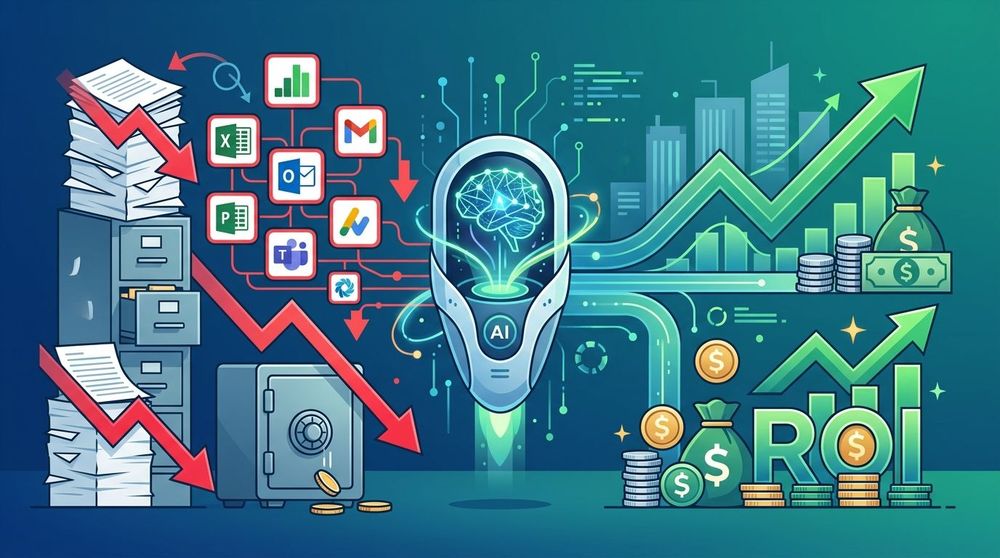
source: own elaboration
Why Do Modern Companies Calculate ROI Before Implementing AI Systems?
In the era of dynamic digital transformation, companies in the Polish and European markets are moving away from treating artificial intelligence as a technological novelty. AI is becoming a key element of operational cost optimization strategies. Business decision-makers – Chief Financial Officers (CFOs), e-commerce managers, and business owners – are analyzing the Return on Investment (ROI) metric ever more meticulously before deciding to allocate budget to new software.
The traditional approach to automation, based on rigid rules (e.g., classic RPA systems), is no longer sufficient when faced with dynamically changing market data, competitor pricing, or non-standard customer inquiries. Implementing a flexible, autonomous Agentic AI class solution allows for the consolidation of multiple scattered tools (such as price monitoring systems, external data integrators, content generators, or dedicated scripts) into a single, cohesive architecture.
Calculating ROI before implementation is essential for three reasons:
- Protection against 'Agent-Washing': As warned by the Gartner report, up to 40% of AI agent-based projects could be canceled by 2027 due to a lack of a clear business strategy and the deployment of solutions mismatched to actual needs. A reliable financial analysis helps avoid this risk.
- Understanding the Cost Structure (TCO): Companies must weigh the one-time implementation cost and the recurring maintenance subscription against actual savings in labor hours, licenses for other software, and the elimination of human errors.
- Identification of Operational Bottlenecks: Pre-implementation analysis precisely pinpoints processes that generate the greatest waste of time, such as manual data entry from Excel files, competitor price verification, or manual processing of repetitive orders.
Key Fact: According to the Microsoft Work Trend Index 2025 report, as many as 84% of business leaders plan to implement artificial intelligence agents within the next 12–18 months to relieve their teams of routine operational tasks.
Savings Potential Comparison: Traditional Tools vs. Dedicated AI Agent
To precisely illustrate the financial advantage of an integrated AI agent over traditional, fragmented automation systems, the table below compares key savings categories based on market data from European implementations.
| Savings Category | Traditional Automation (RPA / Scripts) | Dedicated AI Agent (e.g., AI Business Agent) | Estimated Value / ROI (According to Research) |
|---|---|---|---|
| Labor Time (Man-hours) | Limited to rigid rules; errors during data format changes require human intervention. | Full autonomy; intelligent data mapping, automatic handling of exceptions. | Reduction of routine task handling time by 40–85% [Source]. |
| Operational Costs (OPEX) | Multiple licensing fees for various tools (price monitoring, OCR, CRM integrators). | Consolidation of processes within a single service; no hidden costs. | Average cost of handling a single process reduced by 67% [Source]. |
| Impact on Conversion and Revenue | Lack of flexibility (e.g., inability to dynamically adjust margins or SEO in descriptions). | Automatic generation of unique descriptions for SEO, dynamic adjustment of prices with margins. | Revenue growth reported by 67% of companies implementing AI in marketing and sales [Source]. |
How the AI Business Agent from TrafficWatchdog Impacts Key Business Areas
AI Business Agent is a tailor-made service dedicated to companies that need advanced process automation, custom integrations with external systems, and recurring IT work that goes beyond standard conversational widgets (such as AI e-Seller or AI Phone).
Implementing the AI Business Agent allows for the comprehensive replacement of repetitive human labor in three main operational areas:
1. Reactive Processes (Real-time Event Response)
The Agent constantly "listens" for events in the company's ecosystem and takes immediate action without staff involvement:
- New Order: Automatically places the order with the supplier via API or the wholesaler's panel, generates a personalized confirmation to the customer, and updates the inventory (ERP) and accounting systems.
- New Lead: Instantly registers the contact in the CRM system (e.g., HubSpot, Pipedrive, Salesforce), performs automatic qualification and lead scoring based on context, then assigns it to the appropriate salesperson and triggers a personalized follow-up sequence.
- Status Changes: Responds to changes in courier shipment status by automatically sending a notification to the customer, or verifies stock levels and automatically reorders goods from the manufacturer when inventory falls below a specified threshold.
2. Recurring Processes (Automation at Regular Intervals)
Instead of forcing employees to perform daily, monotonous data checks, the Agent executes these tasks in the background:
- Price and Availability Monitoring: Scans competitor prices hourly, compares them with manufacturer price lists, and automatically updates the store's offerings, ensuring the desired margin is maintained.
- Product Data Updates: Pulls new items from the wholesaler, automatically translates descriptions, optimizes them for SEO (according to search engine guidelines), and synchronizes inventory levels.
- Reporting and Alerts: Generates daily sales reports sent in the morning or triggers alerts for products that have not sold in a long time.
Real-Life Example (Lighting Wholesaler): Before implementation, an employee spent 2 hours every day manually checking stock levels and prices across 15 different suppliers. After implementing the AI Business Agent, the process runs every 2 hours, automatically pulling data, calculating margins, and creating descriptions for new products. The employee now spends only 10 minutes a day on final verification.
3. Custom IT Work (One-off and Periodic Deployments)
The service also includes advanced technical support delivered using AI technologies, which drastically reduces the costs of traditional development:
- Data Scraping and Migration: Securely extracts product data from external websites and uploads it to a new store platform (e.g., Shoper, PrestaShop, WooCommerce) with data category mapping.
- System Integrations: Connects the store with any ERP, CRM, accounting software (Fakturownia, iFirma), or marketplace platforms (Allegro, Amazon).
- Functional Modifications: Implements advanced filters, configures Google Analytics/GTM tracking tags, or optimizes automated transactional emails.
Cost Structure and Implementation Packages
Every implementation of the AI Business Agent begins with a free analysis and quote. For recurring processes, TrafficWatchdog offers a transparent subscription model combined with a one-time implementation fee:
- Starter Package (PLN 2,500/month + PLN 2,500 implementation): An individually configured AI Agent that effectively replaces the repetitive work of 1 employee.
- Growth Package (PLN 5,000/month + PLN 5,000 implementation): An advanced AI Agent that optimizes processes and replaces tasks performed by 2 employees, with priority IT support.
- Pro Package (PLN 7,500/month + PLN 7,500 implementation): A comprehensive automation system that replaces the work of 3 employees, dedicated to large enterprises requiring multi-level integrations.
For one-off projects (such as writing a dedicated scraper or data migration), the quote is determined individually – simpler scripts and automations start from just a few hundred PLN.
European Perspective: Legal Regulations, GDPR, and the AI Act
Implementing autonomous AI agents in enterprises operating within the European Union requires compliance with strict legal requirements. The intersection of personal data protection regulations (GDDR/GDPR), the EU AI Act, and local labor codes imposes specific obligations on companies.
The EU AI Act and High-Risk Systems
The groundbreaking regulation known as the EU AI Act introduces a classification of artificial intelligence systems based on the risk they generate. The key entry-into-force date for the most stringent obligations regarding High-Risk systems is August 2, 2026.
An AI Agent may be classified as a high-risk system (in accordance with Annex III) if it is responsible for:
- Qualification and evaluation of candidates in recruitment processes (HR).
- Making decisions on granting credit ratings in B2B transactions.
- Managing critical digital infrastructure or automated insurance profiling.
Implementing such a system requires undergoing a detailed Fundamental Rights Impact Assessment (FRIA), registration in the EU database, and keeping detailed system logs for at least 6 months.
GDPR Compliance and the 'Black Box' Challenge
One of the greatest challenges at the intersection of GDPR and artificial intelligence is the requirement for transparency and explainability of decisions. According to the legal analysis by rpms.pl, enterprises implementing algorithms that make automated decisions must ensure users can understand the decision-making path. In the case of LLMs, characterized by neural network structures, this can be technically challenging.
Additionally, companies must strictly ensure that customers' personal data is not used to train public language models. In the case of TrafficWatchdog implementations, data security is treated as a priority – integrations are configured using dedicated API keys controlled by the client, and access to sensitive databases is restricted to the bare minimum.
Labor Law and the Human-in-the-Loop Principle
Process automation using AI agents directly impacts employment structures. European labor law obligates employers to ensure human oversight over decisions made by autonomous systems (human-in-the-loop). This aims to counteract the phenomenon of AI Bias embedded in training data, which could lead to discrimination (e.g., in automated rejection of recruitment applications or customer segmentation).
Key Fact: According to PwC Poland research, although as many as 75% of Polish enterprises are implementing AI-related projects, the lack of clear internal procedures and a competency gap among employees remain barriers holding back the full scaling of production deployments.
How to Calculate ROI for Your Company?
To calculate the estimated return on investment before implementing the AI Business Agent, use the following framework based on the methodology used by European research institutes:
-
Step 1: Determine the Cost of Labor Time (As-Is) Identify a repetitive process (e.g., manually updating prices in the store). Multiply the number of hours spent on this task per month by the employee's hourly rate (including employer costs). Example: 2 hours per day × 21 business days = 42 hours. Employee cost: PLN 50/h. Total: PLN 2,100 per month.
-
Step 2: Estimate Opportunity Cost and Errors Add losses resulting from human errors (e.g., pricing mistakes, order fulfillment delays) and lost opportunities (time the employee could have dedicated to direct sales or key account management).
-
Step 3: Compare Costs with the AI Business Agent Offer Compare current costs with the subscription and implementation quote. Remember that the Agent works 24/7, does not get sick, and does not need vacation. In the Starter Package (PLN 2,500/month), you get full automation of work equivalent to one full-time employee, freeing up human resources for higher-margin tasks.
-
Step 4: Apply the ROI Formula $$ ext{ROI} = rac{ ext{Annual Savings} - ext{Implementation and Maintenance Costs (Year 1)}}{ ext{Implementation and Maintenance Costs (Year 1)}} imes 100%$$
In most structured e-commerce processes, investing in a dedicated AI agent pays off within the very first months of launching the system.
Frequently Asked Questions
How does the AI Business Agent differ from a standard chatbot or voicebot?
Ready-made products, such as AI e-Seller or AI Phone, are solutions with a fixed scope of action (e.g., widget support on a website, generating draft emails in Gmail, or answering phone calls). The AI Business Agent is a fully personalized and custom-tailored service. It includes any custom integrations, process automations, and dedicated IT work that go beyond the capabilities of standard assistants.
What specific business processes can we automate under this service?
Automations and tasks within the service are based on three main pillars:
- Reactivity (event-triggered processes): automatic system response to, for example, a new order, status change, or acquiring a new lead.
- Recurrency (time-based processes): tasks executed at regular intervals, e.g., hourly price checks at manufacturers, daily inventory updates, or weekly reporting.
- Custom IT (dedicated work): one-off or periodic technical support, such as preparing a data-scraping scraper or database migrations.
Does every implementation within the AI Business Agent require the use of artificial intelligence?
No. Part of the work performed consists of classic, proven software development services (e.g., writing a scraper or deploying an update script in the store). Artificial intelligence is implemented as an additional layer where it brings real value: in interpreting and structuring unusual data, making contextual decisions, or generating unique content. Regardless of the technology used, the entire scope of work is delivered within a single, cohesive service.
How does the integration of the AI Business Agent with our B2B systems work?
The integration is fully flexible and adapted to your company's technical infrastructure. The AI Business Agent can connect directly to CRM systems, e-commerce platforms, external databases, and supplier systems. In the absence of ready-made APIs, we can prepare a dedicated scraper that automatically extracts and synchronizes data (e.g., uploading products directly from the manufacturer's website into your store).
In what ways is an AI-powered Agent better than a traditional, simple script?
A classic script works in a rigid, unreflective way – copying data in a 1:1 format, failing to handle file errors, and stopping immediately when any exceptions occur. An AI-powered Agent introduces a layer of intelligent interpretation: it can automatically calculate prices taking margins into account, compare them with competitors, rewrite product descriptions for SEO in your store's language, and respond flexibly to unusual data formats.
What are the implementation and maintenance costs for such a solution?
Since the AI Business Agent is a service designed individually for the specifics of each enterprise, the implementation cost depends directly on the complexity of the integration and the scope of required software development work (Custom IT). Before starting, we thoroughly analyze your needs, which allows us to eliminate fees for redundant, unused features and precisely estimate the return on investment (ROI).
Summary
Implementing the AI Business Agent from TrafficWatchdog is a strategic step toward building a competitive advantage and radically reducing operational costs in your company. Instead of investing in multiple uncoordinated tools, enterprises can consolidate their processes within a single, intelligent system.
Key Takeaways:
- Real Financial and Time Savings: Automating routine tasks reduces labor time spent on repetitive processes by 40–85% and lowers the operational costs of individual tasks by an average of 67%.
- Three Pillars of Flexibility: The AI Business Agent combines reactive processes (real-time response to events), recurring processes (continuous monitoring of prices and stock levels), and custom software development work (Custom IT).
- Full-time Equivalent (FTE) Replacement in a Clear Model: The Starter, Growth, and Pro packages precisely define the number of replaced employees (from 1 to 3), making hard ROI calculations easier.
- Regulatory Compliance: Professional implementation guarantees complete data security and compliance with the upcoming requirements of the EU AI Act (August 2026) and GDPR.
- Free Start: Every project begins with a free, no-obligation technical analysis and an individual quote tailored to the scale of the company's operations.