Customer Returns 4 Times Without Buying? How Sales Bot Closes the Deal
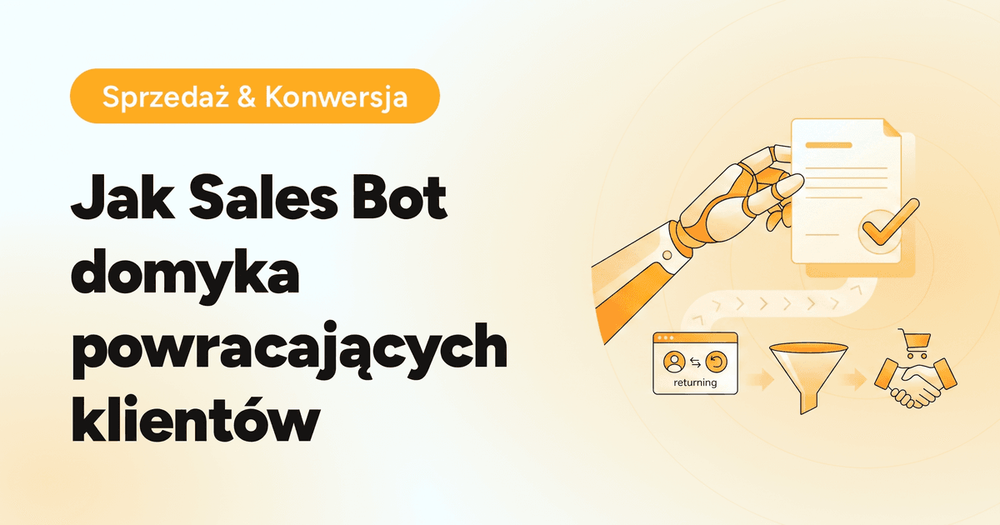
source: own elaboration
Most users visiting online stores do not make a purchase during their first visit. In European e-commerce, the customer journey is increasingly fragmented - consumers across Germany, France, and Poland compare offers across multiple browser tabs, check competitor prices, and return to the product page multiple times. Every repeat visit, especially those driven by paid Google Ads or Meta Ads campaigns, incurs a cost. When a user lands on a store for the third or fourth time and still hesitates before completing the transaction, the risk of losing them permanently grows with every passing hour.
Many marketers attempt to address this issue with mass discount pop-ups displayed to everyone or with complex generative AI assistant implementations. However, both approaches carry serious challenges: generic pop-ups drastically erode profit margins on high-intent buyers, while generative chatbots carry hallucination risks and high budget barriers. The solution bridging this gap is Sales Bot by TrafficWatchdog - a specialized on-site sales widget based on structured, predefined pathways that activates at the critical decision-making moment and closes the sale through intelligent discounting.
Key takeaway: As highlighted in the Neuwark report on conversational selling in e-commerce, implementing automated mechanisms within sales funnels can increase the overall conversion rate by 15% to as much as 30%, effectively eliminating hesitation at the final decision stages.
Anatomy of Hesitation: Why Are You Paying for Indecisive Visitors?
When a potential buyer clicks on your ad repeatedly, it indicates strong interest in your catalog, but also points to a specific purchase barrier. Most often, this barrier is price sensitivity, the lack of an immediate trigger, or hesitation over making the wrong choice.
Without precision tools on-site, an e-commerce store typically responds in one of two extreme ways:
- Zero action: The shopper leaves the store once again, encounters a competitor's offer, and buys from them. The advertising budget spent on acquiring that user via Google Ads is burned for good.
- Blind discounting: Triggering an aggressive modal popup with a discount code for every single visitor. As a result, the store surrenders valuable margin on customers who were already prepared to pay full price.
According to data from LoopEx Digital research on CRO statistics, users interacting with dedicated on-site assistants are up to 4 times more likely to take action compared to passive traffic. The core challenge lies in delivering the right incentive exclusively to shoppers who genuinely require that extra push.
What Is Sales Bot and How Does It Work in Practice?
Sales Bot is a dedicated sales-closing widget designed to detect hesitant visitors and guide them through a structured, fully pre-programmed deal-closing flow. The defining advantage of Sales Bot is its complete predictability - the tool does not generate open-ended answers using Large Language Models (LLMs), but instead leads the customer through pre-set question-and-answer choice buttons.
The Sales Bot mechanism works across five clear steps:
- Hesitant visitor identification: The system analyzes on-site user behavior. It identifies shoppers logging repeat sessions (e.g., a 3rd or 4th visit), viewing specific product categories, or spending substantial time on-site without initiating checkout.
- Price profiling and bot trigger: Once predefined trigger conditions are met (e.g., 3rd visit originating from a paid ad campaign), the widget activates. The bot does not bombard the visitor on their first touchpoint - it appears only when clear hesitation is detected.
- Structured sales chat: Sales Bot initiates a brief, predefined interaction. The customer clicks predefined answer buttons, clarifying their intent instantly without typing a single word.
- Discount code delivery and product recommendations: The bot provides a tailored discount code alongside an interactive product carousel matched to browsing history or top-selling items.
- Post-purchase upsell: Once the main purchase is finalized, the bot can suggest complementary accessories or add-on items, driving up the Average Order Value (AOV).
Key takeaway: According to IBM research on conversational tools efficiency, the average return on investment (ROI) for enterprise shopping assistant solutions stands at $4.20 for every dollar invested, with e-commerce deployments delivering rapid payback periods.
Smart Discounting Without Margin Burn: 3 AI Profiling Segments
To prevent giving away unnecessary discounts to ready-to-buy customers, Sales Bot includes an optional AI-driven user behavior profiling module. The analytics model assesses purchase probability and segments returning visitors into three distinct strategic tiers:
- High-Intent Profile (Green): The user shows a very high likelihood of completing a purchase based on navigation patterns. Strategy: the bot offers no discount or only a small token gift/minimal perk, protecting store margins.
- Medium-Intent Profile (Yellow): Moderate purchase likelihood. The user is hesitating and comparing products. Strategy: the bot offers a balanced incentive discount that nudges them to finalize checkout immediately.
- Low-Intent Profile (Red): The user has a low purchase probability and is likely to leave for a competitor without an added push. Strategy: delivering a higher discount that tips the scale in your store's favor.
To implement this approach, the store administrator provides 3 distinct coupon codes assigned to each respective tier. Consequently, discounting transforms into a precise margin arbitrage mechanism rather than an indiscriminate site-wide expense.
Key Technical Capabilities of Sales Bot
Sales Bot combines frictionless customer usability with powerful configuration rules managed directly through the TrafficWatchdog control panel:
1. Flexible Voucher Management
The tool supports three discount distribution models to fit your pricing strategy:
- Static promo codes (Standard): Fixed codes linked to specific user paths or segments.
- Unique single-use codes (CSV/Excel list): Bulk import of unique promo codes. Each customer receives a one-time coupon code, preventing leaks to coupon aggregator websites or social media groups. If the code pool runs low, the system dispatches an automated email alert.
- Link-activated discounts: Seamless discount application directly in the cart via a single click on the generated bot link.
2. Dynamic Product Carousel
Inside the chat window, shoppers interact with a visual product carousel in addition to text prompts. Products are populated in two ways: dynamically based on current session browsing data (integrated with Google Merchant Center feeds or XML) or manually by highlighting bestsellers and seasonal specials.
3. Google Ads Remarketing Audience Sync
A standout capability of Sales Bot is the ability to automatically tag visitors who interact with the widget and sync them directly into custom Google Ads remarketing audiences. This allows you to deploy targeted follow-up campaigns outside your store specifically for users who received a discount code but have yet to redeem it.
Comparison: Standard E-Commerce vs. Store Powered by Sales Bot
The table below highlights the operational and commercial differences between a standard online store setup and one enhanced by a guided sales widget:
| Operational Area | Standard E-Commerce (No Sales Bot) | E-Commerce with TrafficWatchdog Sales Bot |
|---|---|---|
| Handling repeat visits (3rd-4th session) | No intervention; store pays for repeated ad clicks without conversion effort | Automated launch of the discount closing flow precisely at the moment of hesitation |
| Margin and discount strategy | Blanket pop-up discounts for all visitors or no discounts, leading to lost sales | Optional 3-tier AI profiling - higher discounts reserved exclusively for hard-to-convert shoppers |
| Coupon code protection | Generic public codes get leaked to coupon scrapers and deal portals | Unique one-time codes from CSV pools with automated low-stock warnings |
| Compliance and predictability | Static banners or hallucination risks in unconstrained generative AI bots | 100% deterministic script (zero hallucinations) and full EU transparency compliance |
| Google Ads campaign efficiency | Rising customer acquisition costs (CAC) due to redundant ad clicks | On-site checkout closing + automated feed into custom remarketing audiences |
When to Choose Sales Bot vs. AI E-Salesperson?
TrafficWatchdog offers two complementary conversational solutions built for distinct business objectives:
- AI E-Salesperson: A full Large Language Model capable of handling open-ended, multilingual dialogues. Recommended for larger stores where customers ask complex technical, fitment, or product advisory questions and expect real-time conversational guidance.
- Sales Bot: A lean widget operating on deterministic decision trees (users navigate via clickable response buttons). It is the ideal choice for small-to-medium stores, brands with tighter setup budgets, or merchants looking strictly for a precise cart recovery and margin-safe discounting tool with zero risk of conversational errors.
Sales Bot pricing at TrafficWatchdog starts at 200 PLN / month for the Starter plan (up to 10,000 sessions), 350 PLN for Growth (up to 30,000 sessions), and 500 PLN for Pro (up to 60,000 sessions), offering an accessible CRO upgrade for stores of all sizes.
Regulatory Compliance and European Standards (GDPR & EU AI Act)
Deploying sales automation software in the European Union requires strict adherence to legal frameworks. In light of the Travers Smith legal analysis regarding AI Act transparency requirements, automated digital tools interacting with consumers must clearly disclose their automated nature. Sales Bot operates with complete regulatory peace of mind:
- Transparency by design: From the opening message, users clearly recognize they are interacting with an automated promotional assistant.
- Data privacy (GDPR): Session-level profiling and discount assignment do not require processing sensitive personal identifiers, and integrations comply with European data processing agreements.
- Zero hallucination liability: Fixed dialogue branches remove the danger of misquoting product specifications, store policies, or inventory availability.
Furthermore, the APMP and Responsive study on UK and EU markets indicates that European enterprises are moving away from unmanaged tech experiments toward verified, fully transparent tools delivering fast returns on investment (ROI under 6 months for the vast majority of surveyed businesses).
Step-by-Step Sales Bot Implementation Guide
Sales Bot integration is built to require minimal technical overhead from store development teams. The standard rollout follows a straightforward workflow:
Expand step-by-step Sales Bot setup instructions
The Sales Bot setup is hassle-free and typically completed within 24 to 48 hours:
- Dashboard registration: Create your account inside the TrafficWatchdog customer panel.
- Discount configuration: Define static voucher codes or upload a CSV/Excel file containing unique single-use coupon codes.
- Product feed integration: Connect your catalog feed (Google Merchant Center, XML, or API) to power dynamic product carousel recommendations.
- Trigger rule configuration: Set up activation criteria (e.g., trigger only on the 3rd session, after a specific session duration, or for traffic from selected ad campaigns).
- Visual customization: Align brand colors, logo, widget screen position, and copy to match your store branding.
- Script installation: Deploy via ready-made 1-click plugins (available for Shopify, WooCommerce, PrestaShop, Magento, WordPress, Shoper, IdoSell) or paste a lightweight JavaScript snippet with support from the TrafficWatchdog tech team.
Frequently Asked Questions (FAQ)
Can users type open-ended questions into Sales Bot?
No. Sales Bot relies strictly on predefined click-based pathways (selection buttons). This ensures shoppers reach their discount and relevant product suggestions instantly, while the store owner maintains 100% control over the messaging. For stores requiring open-ended customer dialog, the AI E-Salesperson is the dedicated solution.
What happens if the pool of unique promo codes runs out?
When utilizing unique single-use codes via CSV/Excel upload, TrafficWatchdog continuously monitors available inventory. Once the number of remaining codes drops below a safe threshold, the platform dispatches an automated email reminder to upload fresh codes, ensuring no visitor ever receives an empty promo response.
How does Sales Bot integrate with Google Analytics and campaign ROAS tracking?
Sales Bot automatically sends interaction events into web analytics platforms, including Google Analytics 4 (GA4). This enables granular attribution of bot-assisted conversions to evaluate the direct uplift in ROAS and overall marketing campaign returns.
Key Performance Indicators
| Metric | Before Implementation | After Implementation | Source |
|---|---|---|---|
| Conversion Rate (CR) | Standard baseline conversion rate (high drop-off among indecisive visitors) | 15% to 30% increase across key funnel touchpoints | Neuwark Conversational Selling Report |
| Average Order Value (AOV) | Single item checkout without additional basket building | Cart expansion driven by product carousels and post-purchase upsells | TrafficWatchdog Sales Bot Documentation |
| Ad Spend Efficiency (ROAS / CAC) | Escalating CAC from repeated empty ad clicks | Monetization of repeat paid traffic at the pivotal decision phase | TrafficWatchdog Sales Bot Documentation |
| Gross Margin Protection | Margin erosion through public coupons and generic mass pop-ups | Targeted discounts allocated only to hesitating shoppers (e.g., 3rd visit) | Sales Bot Dynamic Pricing Profiling |
Summary
Hesitant customers visiting your store multiple times represent an enormous revenue opportunity that standard online stores fail to capture, resulting in wasted ad spend. Deploying Sales Bot closes this conversion gap in a predictable, scalable, and margin-safe manner.
- Stop burning paid traffic: The bot triggers precisely when a shopper hesitates again, intercepting them before they bounce to a competitor.
- Total margin control: Optional 3-tier AI profiling tailors discount depths to the individual shopper's purchase propensity.
- Brand safety guaranteed: Deterministic dialogue scripts eliminate hallucinations and erroneous statements while ensuring full EU compliance.
- Rapid deployment: Ready-to-use plugins for Shopify, PrestaShop, WooCommerce, and other major platforms enable setup within minutes.
- Low barrier to entry: Transparent monthly subscription plans starting at 200 PLN empower stores of any size to elevate conversion efficiency immediately.